


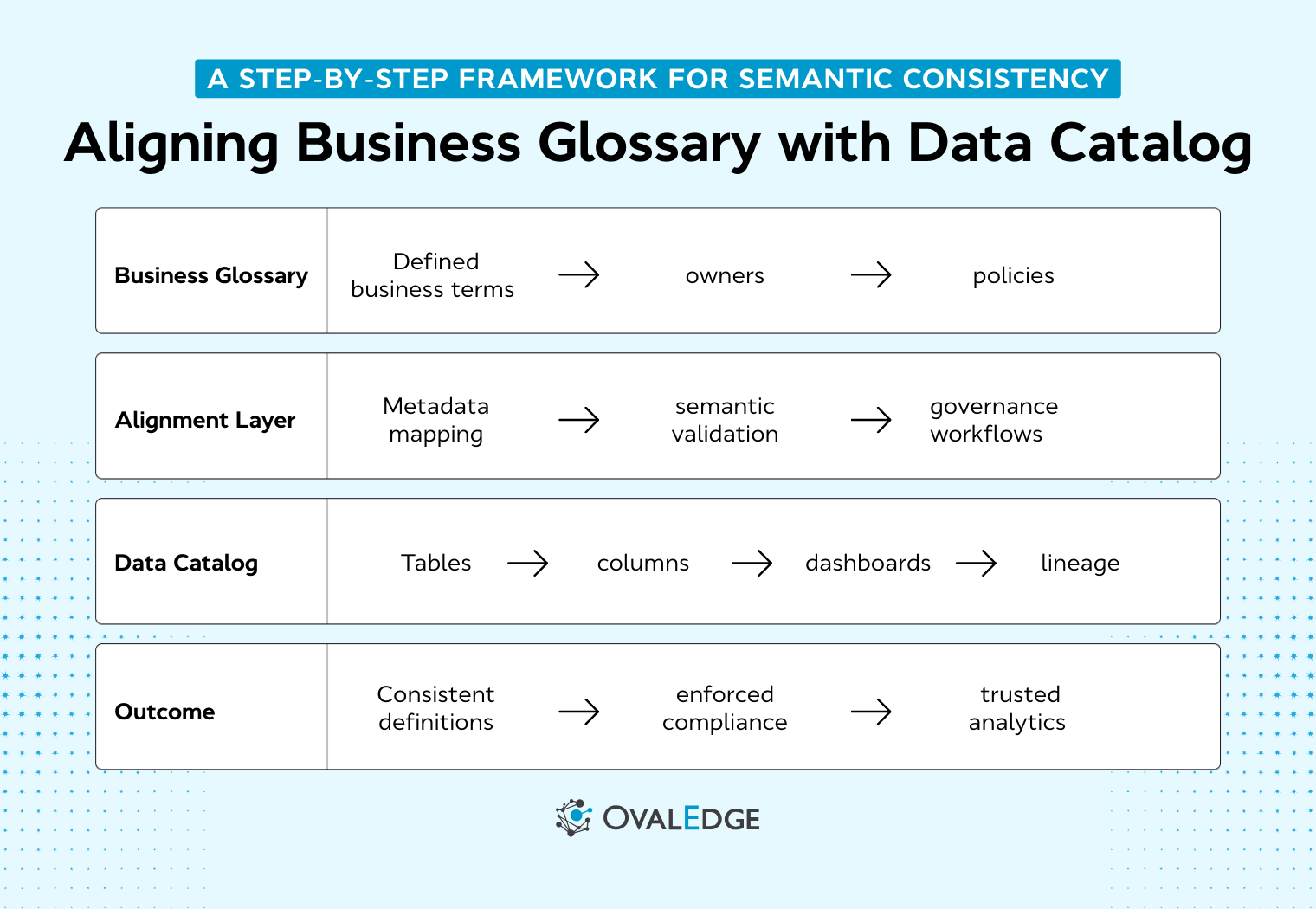
Organizations often struggle with inconsistent metrics because business definitions and technical data structures evolve separately. Aligning a business glossary with a data catalog connects business terms directly to operational data assets, ensuring consistent interpretation across reports and analytics systems. This guide explains how glossary–catalog alignment improves semantic consistency, governance enforcement, and trust in data. It outlines a step-by-step framework, metadata mapping strategies, architectural considerations, and common implementation challenges. By following these practices, organizations can establish a governed foundation for reliable analytics and decision-making.
A finance lead opens the monthly revenue dashboard and sees one number, while the sales team reports a different figure for the same metric. The data team confirms the query is correct. The problem is not the pipeline but the definition of “revenue.” When business terms and technical data structures are misaligned, even accurate systems can produce conflicting insights.
This trust gap is common.
A 2023 Deloitte poll found that 21% of executives involved in digital trust programs lack confidence in their organizations’ ability to protect and manage data. Misaligned definitions, fragmented metadata, and disconnected governance processes often drive that uncertainty.
This is why aligning business glossary with data catalog is essential. By linking business terms to technical data assets, organizations can standardize definitions, strengthen governance, and ensure analytics reflect a consistent understanding of data.
In this guide, we explain how glossary and data catalog integration works, why many governance programs struggle to achieve it, and the framework organizations can use to implement it effectively.
What does glossary and data catalog alignment mean in practice
Aligning business glossary with data catalog means connecting business definitions directly to the technical data assets that represent them. A business glossary contains approved business terms, definitions, ownership, and classifications, while a data catalog inventories technical assets such as datasets, tables, columns, dashboards, and data lineage.
Alignment occurs when glossary terms are mapped to the corresponding data assets in the catalog so that business meaning reflects how data is actually used across systems. For example, a term like active customer is not just documented in the glossary. It is associated with the datasets, columns, transformations, and dashboards where that metric appears in analytics and reporting.
This alignment helps ensure that business and technical teams rely on the same definitions when interpreting data. Reports use standardized terminology, data assets become easier to understand, and data stewards can evaluate how changes in datasets or schemas may affect business metrics.
|
Pro Tip: By connecting definitions with operational data assets, organizations create a consistent foundation for governance, analytics, and decision-making. |
Why is aligning business glossary with data catalog critical
Aligning the business glossary with data catalog ensures that business definitions remain consistent across technical systems. When terminology and metadata are connected, organizations can improve governance, reduce reporting conflicts, and increase trust in analytics.
Ensure semantic consistency
Semantic drift often begins when different teams interpret the same term differently. For example:
-
Marketing defines an active user based on 30-day engagement
-
Product teams measure it using 14-day activity.
-
Finance excludes trial accounts from customer counts.
-
Sales includes those users in the reporting.
Although the term looks consistent, its meaning varies across teams. This leads to conflicting KPIs, inconsistent dashboards, and delayed decision-making.
Aligning the business glossary with the data catalog prevents this drift by ensuring one governed definition that is:
-
Version-controlled and owned by a responsible stakeholder
-
Linked to the relevant tables, columns, and dashboards
Through business glossary mapping, organizations ensure that approved definitions are consistently applied across analytics and reporting systems.
Strengthen governance and compliance
Data governance policies are effective only when they are tied to actual data assets. Classifying customer email as sensitive data is useful only if that classification is connected to the database columns and datasets where the information exists.
Integrating the glossary with the data catalog enables governance rules, classifications, and access policies to attach directly to technical metadata. This connection allows organizations to track sensitive data, enforce compliance requirements, and simplify audit processes.
Improve metadata trust and adoption
Trust in analytics declines when users cannot easily understand how metrics are defined or calculated. When definitions are unclear or hidden, teams often rely on spreadsheets or locally interpreted metrics instead of shared data platforms.
Aligning the business glossary with the data catalog improves transparency. Users can search for a business term, view its approved definition, and quickly locate the datasets or dashboards where the concept appears.
This visibility improves the usability of enterprise data platforms and supports broader adoption of self-service analytics by:
-
Reducing clarification cycles between business teams and data engineers
-
Helping analysts quickly interpret unfamiliar datasets
-
Increasing confidence in shared reports and dashboards
Glossary vs Data Dictionary vs Data Catalog
These terms are often used interchangeably, but they serve different roles in data governance and data management. Understanding the distinction helps organizations structure their metadata strategy more effectively.
|
Component |
Purpose in Data Governance |
Information Captured |
Primary Users |
|
Business Glossary |
Defines approved business terminology used across the organization |
Business terms, definitions, ownership, classifications, governance policies |
Business teams, analysts, data stewards |
|
Data Dictionary |
Documents the technical structure of databases |
Column names, data types, constraints, and system attributes |
Data engineers, database administrators |
|
Data Catalog |
Organizes and enables the discovery of enterprise data assets |
Datasets, tables, dashboards, lineage, usage metadata, business context |
Data analysts, engineers, business users |
Each of these components plays a distinct role in managing and understanding enterprise data. When used together, they create a complete metadata framework where business meaning, technical structure, and data discovery are connected.
Step-by-step framework for aligning business glossary with data catalog
Here is the nine-step framework we can use to operationalize aligning business glossary with data catalog. While presented sequentially, alignment is iterative and requires continuous refinement as business definitions, metadata, and reporting environments evolve.
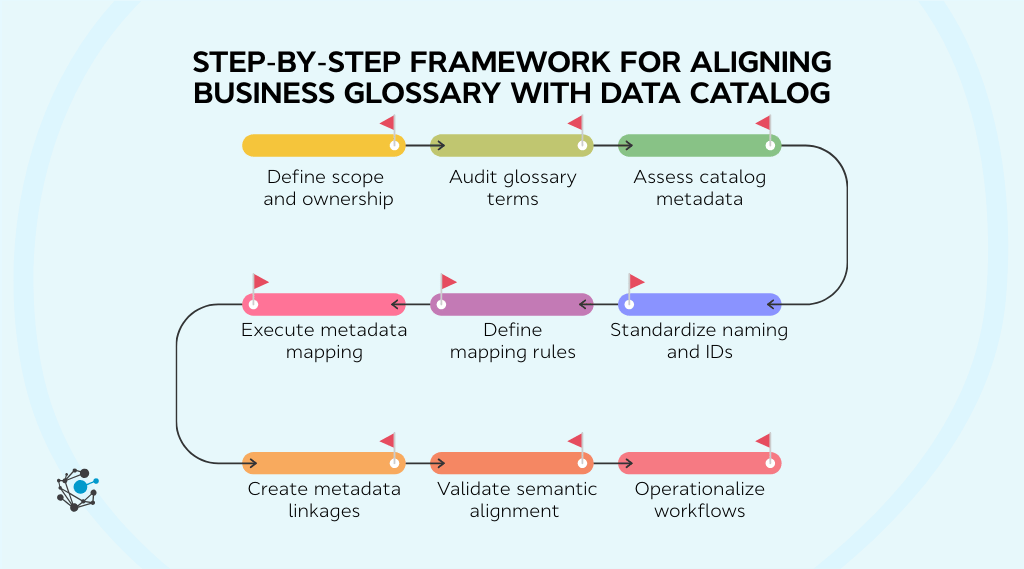
Step 1: Define scope and ownership
We begin with business domains where data inconsistencies already affect decision-making, such as finance, sales, marketing, or customer operations. Starting with high-impact domains allows us to demonstrate governance value quickly.
We also assign clear accountability. Each priority term should have a business owner, a data steward, and a technical validator responsible for approving definitions, validating mappings, and monitoring semantic drift. Without defined ownership, glossary initiatives often stall before alignment is achieved.
Step 2: Audit glossary terms
Next, we review the current glossary and classify terms as approved, duplicate, deprecated, or undefined. Many organizations discover that the same business concept appears multiple times with slightly different definitions.
We then prioritize high-impact terms, particularly those used in executive reporting, regulatory submissions, and cross-functional dashboards. Aligning these terms first delivers the fastest governance impact.
Step 3: Assess catalog metadata
Before mapping begins, we evaluate the quality of the data catalog metadata. Alignment requires sufficient technical context across tables, columns, dashboards, and lineage.
We should check for:
-
Column-level metadata completeness
-
Data lineage availability
-
Asset ownership information
-
Consistent dataset naming conventions
If catalog metadata is incomplete, glossary terms cannot be reliably connected to technical assets.
Step 4: Standardize naming and IDs
We establish naming conventions for both glossary terms and data assets to reduce confusion caused by synonyms such as customer, client, account, or subscriber.
We also assign unique identifiers to glossary terms. These identifiers help track definition changes, maintain mapping history, and distinguish approved canonical terms from aliases.
Step 5: Define mapping rules
This step defines how business terms relate to technical assets. We establish mapping relationships such as:
-
One-to-one for direct equivalence
-
One-to-many when one term maps to multiple columns
-
Many-to-one when multiple fields represent a single concept
-
Many-to-many for complex cross-domain constructs
We also define validation criteria to determine whether the mapping represents a source field, a derived metric, or a transformation-based calculation.
Step 6: Execute metadata mapping
Once the rules are established, we map glossary terms to tables, columns, views, dashboards, and analytical metrics. Automation can suggest likely matches based on metadata patterns, but steward review remains essential.
Automation accelerates discovery, while domain experts confirm that the technical asset accurately represents the business concept.
Step 7: Create metadata linkages
After mapping rules and validations are complete, we operationalize the alignment by linking approved glossary terms to cataloged assets. This ensures that definitions are visible within the datasets, columns, and dashboards where the metric is implemented.
When users access a dataset or report, they can immediately see the associated business definition, making it easier to interpret metrics correctly. This also helps stewards understand how changes in schemas or datasets may affect business concepts used in reporting.
|
Implementation Insight: OvalEdge’s Practical Guide to Improving Data Traceability Using Business Glossary highlights that connecting glossary terms with cataloged assets, lineage, and ownership improves traceability and ensures business definitions remain anchored to operational data. |
Step 8: Validate semantic alignment
Mapping alone does not guarantee semantic accuracy. We need to verify mappings using lineage, transformation logic, and data quality indicators.
For example, if a glossary term represents net revenue but the mapped dataset contains gross sales, the mapping is incorrect even if column names appear similar. Semantic validation ensures the technical implementation matches the business meaning.
Step 9: Operationalize workflows
Finally, we embed glossary alignment into ongoing governance workflows. Alignment must be maintained as schemas evolve and business definitions change.
At a minimum, we monitor:
-
Schema changes affecting mapped assets
-
Business term revisions
-
New dashboards using governed metrics
-
Ownership changes
-
Deprecated mappings
Embedding these controls ensures glossary definitions remain synchronized with the technical metadata used across analytics systems.
Metadata mapping strategies for effective glossary catalog alignment
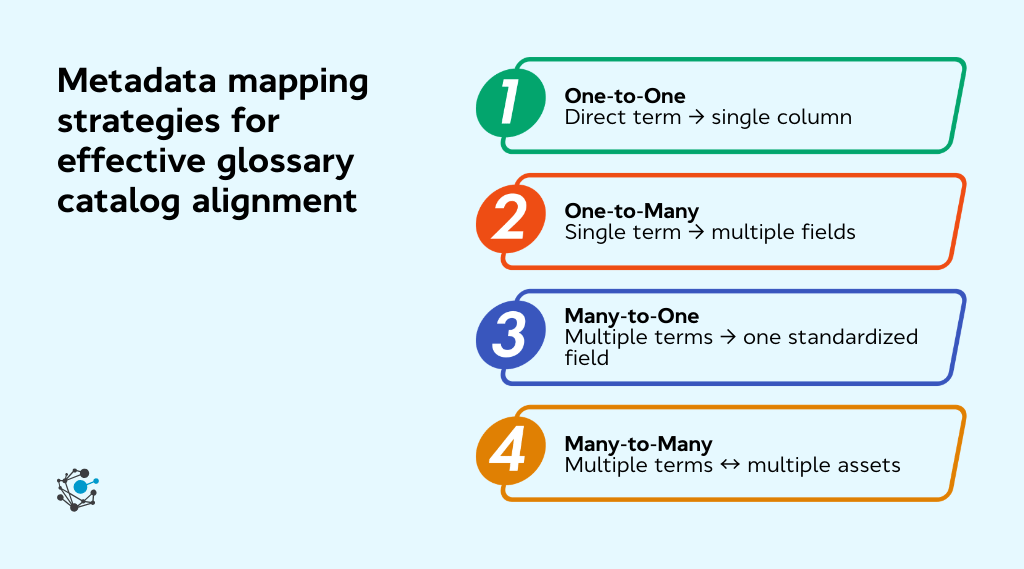
Effective glossary and data catalog alignment depends on selecting the right mapping strategy for each business concept.
Relationship-based mapping
The first step is defining the relationship between a business term and the underlying data assets:
-
One-to-one mapping: One business term linked to a single field (e.g., date of birth mapped to one column).
-
One-to-many mapping: One term connected to multiple fields or datasets (e.g., customer revenue across invoices and subscription systems).
-
Many-to-many mapping: Complex concepts drawing from multiple sources (e.g., profitability combining finance and operational data).
Mapping depth
Mapping can occur at different levels:
-
Attribute-level mapping links terms to specific columns or metrics for precise governance.
-
Entity-level mapping connects terms to broader assets such as datasets or dashboards to improve discoverability.
Supporting practices such as synonym control, lineage validation, and version tracking help ensure that mappings remain accurate as definitions and schemas evolve.
Glossary and data catalog alignment architecture
Effective glossary and data catalog alignment typically follows a layered architecture that connects business meaning with technical metadata and governance controls.
-
Business layer: Contains glossary terms such as revenue, customer, and active user. This layer defines business meaning, ownership, classifications, and policies that standardize terminology across the organization.
-
Metadata layer: Includes cataloged assets such as datasets, tables, columns, dashboards, and pipelines. It represents the technical inventory of where data exists and how it flows across systems.
-
Mapping layer: Connects glossary terms with the corresponding technical assets in the catalog. This layer ensures that business definitions align with the datasets, columns, and metrics used in analytics.
-
Governance layer: Applies policies, stewardship workflows, access rules, and change monitoring to mapped assets. It ensures definitions remain consistent and controlled as data environments evolve.
When these layers operate together, governance becomes operational.
|
Do you know?: OvalEdge highlights an integrated architecture where cataloging, lineage, stewardship workflows, and policy management work together to keep business definitions aligned with evolving data systems. |
Common failure points in glossary catalog alignment and fixes
Even well-planned glossary and catalog initiatives encounter operational challenges. Recognizing common failure points helps organizations design governance controls that keep definitions and metadata aligned over time.
-
Conflicting definitions and unclear ownership: When multiple teams define the same term independently, the glossary loses authority and becomes difficult to govern. Establishing clear stewardship roles and approval workflows ensures that definitions are reviewed, approved, and maintained by accountable owners.
-
Duplicate terms and inconsistent naming: Duplicate terms often appear after acquisitions, domain decentralization, or rapid BI expansion. Regular deduplication audits and controlled vocabularies help maintain one canonical definition for each business concept.
-
Over-linking of glossary terms: Some teams attempt to connect a glossary term to every loosely related dataset or report. This creates noise and reduces clarity. Defining clear relationship criteria and requiring semantic validation before linking helps maintain accurate mappings.
-
Schema change drift: Data structures evolve frequently. Columns may be renamed, transformations updated, or dashboards rebuilt while glossary mappings remain unchanged. Continuous change monitoring and stewardship workflows are essential to detect and update affected mappings.
Modern data governance platforms address this challenge by automating lineage tracking, change detection, and stewardship notifications.
|
For example, OvalEdge emphasizes lineage-driven impact analysis and governance workflows to help teams maintain glossary and catalog alignment as data environments evolve. |
How OvalEdge supports aligning the business glossary with the data catalog
OvalEdge supports aligning business glossary with data catalog by embedding glossary management, metadata discovery, and governance workflows within the same platform.
Instead of managing definitions and technical metadata in separate tools, organizations can standardize business terms and link them directly to data assets within a unified governance environment.
Unified mapping workflows
OvalEdge integrates the business glossary and data catalog within the same governance suite, reducing the handoff between business stakeholders and technical teams.
Business definitions, metadata, and stewardship processes operate in a single platform, allowing organizations to manage terminology and data assets together.
This enables practical workflows such as:
-
Standard term creation and governance
-
Approval and stewardship workflows
-
Direct mapping of business terms to tables, views, columns, and BI reports
By centralizing these activities, teams can maintain consistent definitions while ensuring that business terms remain connected to the data used in analytics.
Automated metadata linkage
OvalEdge’s data catalog connects to a wide range of data sources and captures both active and extended metadata, including usage patterns, permissions, and source-specific attributes. The platform also supports automated discovery, organization, and enrichment of data assets.
Automation helps organizations maintain alignment as data environments evolve. Instead of manually updating mappings, teams can use connector-based ingestion, AI-assisted discovery, and steward validation to keep glossary terms aligned with the underlying datasets and analytical assets.
Governance and change tracking
Maintaining glossary-catalog alignment strengthens both governance and regulatory readiness. OvalEdge supports this through automated classification, lineage tracking, stewardship workflows, and policy monitoring that help teams track how definitions and data assets evolve.
Two governance scenarios highlight the importance of this alignment:
-
AI model input validation depends on glossary alignment: AI models rely on consistent definitions for training data and features. Mapping glossary terms to governed datasets helps ensure model inputs reflect approved business logic.
-
Regulatory audits often begin with defining this metric: Auditors frequently ask organizations to explain how key metrics such as revenue or customer counts are defined and calculated. Glossary–catalog alignment allows teams to trace these definitions directly to the datasets and reports where they are implemented.
By combining governance workflows with lineage visibility, OvalEdge helps organizations maintain semantic alignment while supporting compliance and trusted analytics.
Customer implementations highlight the practical impact of this approach.
|
Case study: Bedrock reports improved data accuracy through integrated glossary and lineage capabilities, while Delta Community Credit Union emphasizes centralized metadata management and improved data literacy across teams as part of its governance initiatives. |
Metrics that prove alignment works
If you cannot measure alignment, you cannot sustain it. The KPI set we recommend includes:
-
Term-to-asset coverage ratio: Percentage of priority glossary terms mapped to validated assets
-
Mapping validation accuracy: Share of mappings approved without semantic rework
-
Search precision improvement: Whether users find the right governed assets faster
-
Reduction in duplicate terms: A direct signal of glossary hygiene
-
Drift detection rate: How often schema or lineage changes trigger mapping review
-
Policy attachment completeness: Percent of sensitive or regulated terms linked to governed assets
KPMG’s 2025 data report is a useful backdrop here. It found that more than 45 percent of respondents cited data quality and accessibility as major challenges, while only 36 percent had formal approaches to data governance and management.
Those numbers make it clear that maturity gaps are still wide, which is exactly why operational KPIs matter.
Conclusion
Aligning the business glossary with data catalog ensures that business meaning remains clear, enforceable, and trustworthy across the systems teams rely on for analytics and decision-making.
When business terms connect to data assets, lineage, and governance controls, organizations reduce ambiguity, strengthen compliance, and improve confidence in reports and AI models.
The best next step is to start with a focused domain such as finance or customer analytics. Identify high-impact terms, assign ownership, define mapping rules, and track alignment metrics to ensure definitions remain consistent as systems evolve.
Platforms like OvalEdge simplify this process by integrating the business glossary, data catalog, lineage, and governance workflows into one environment.

Book a demo with OvalEdge to see how your teams can standardize definitions, maintain semantic alignment, and scale trusted data governance across the enterprise.
FAQs
1. What is the difference between a business glossary and a data dictionary?
A business glossary defines business terms in plain language for organizational clarity. A data dictionary documents technical details such as column names, data types, and constraints. Aligning both ensures business definitions connect directly to physical data structures.
2. How do you prioritize terms for glossary and data catalog alignment?
Start with high-impact metrics used in executive reporting, regulatory submissions, or cross-functional dashboards. Focus on terms with conflicting definitions or high data usage frequency to maximize governance impact and reduce ambiguity quickly.
3. Can glossary catalog alignment support AI and analytics initiatives?
Yes. AI models and analytics systems depend on consistent definitions and reliable metadata. Proper alignment ensures training datasets, feature engineering logic, and reporting metrics reflect approved business definitions, reducing bias and misinterpretation.
4. How often should glossary metadata linkage be reviewed?
Review linkages during schema changes, quarterly governance cycles, or major reporting updates. Automated change detection and steward approvals help maintain continuous alignment without relying solely on manual audits.
5. What roles are essential for maintaining glossary catalog alignment?
Key roles include business data owners, data stewards, and technical metadata managers. Clear accountability prevents definition conflicts, ensures mapping accuracy, and maintains semantic consistency across domains and reporting layers.
6. Does glossary and data catalog integration reduce reporting errors?
Yes. When business terms map directly to validated data assets, teams reduce metric inconsistencies, prevent duplicate calculations, and improve dashboard reliability, leading to fewer reconciliation cycles and stronger executive confidence.
Deep-dive whitepapers on modern data governance and agentic analytics
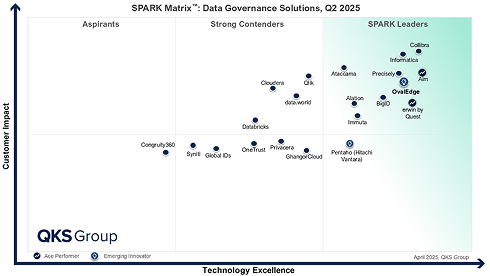
OvalEdge Recognized as a Leader in Data Governance Solutions
3ff1.png)
“Reference customers have repeatedly mentioned the great customer service they receive along with the support for their custom requirements, facilitating time to value. OvalEdge fits well with organizations prioritizing business user empowerment within their data governance strategy.”
aef2.png)
“Reference customers have repeatedly mentioned the great customer service they receive along with the support for their custom requirements, facilitating time to value. OvalEdge fits well with organizations prioritizing business user empowerment within their data governance strategy.”
Gartner, Magic Quadrant for Data and Analytics Governance Platforms, January 2025
Gartner does not endorse any vendor, product or service depicted in its research publications, and does not advise technology users to select only those vendors with the highest ratings or other designation. Gartner research publications consist of the opinions of Gartner’s research organization and should not be construed as statements of fact. Gartner disclaims all warranties, expressed or implied, with respect to this research, including any warranties of merchantability or fitness for a particular purpose.
GARTNER and MAGIC QUADRANT are registered trademarks of Gartner, Inc. and/or its affiliates in the U.S. and internationally and are used herein with permission. All rights reserved.