


.png)
Organizations often struggle with inconsistent business definitions across reports and dashboards, which leads to confusion, reporting disputes, and reduced trust in data. A structured business glossary implementation plan helps standardize business terminology and connect definitions with datasets, lineage, and analytics systems. This guide explains how to implement a glossary step by step, including defining governance ownership, prioritizing key terms, designing workflows, and integrating glossary definitions with data assets.
In many organizations, the same metric can mean different things to different teams. Finance calculates revenue one way, sales dashboards show another number, and product analytics reports something else entirely. When business definitions are inconsistent, data trust erodes, and governance teams struggle to enforce standards.
A business glossary helps solve this problem by establishing shared definitions for business terms, metrics, and KPIs. But creating a glossary document alone rarely fixes the issue. Without a structured implementation plan, definitions remain disconnected from the datasets, pipelines, and dashboards that actually generate the numbers people rely on.
This is why organizations need a clear business glossary implementation plan. Instead of treating glossary creation as a documentation exercise, a structured rollout connects business terms with technical metadata, governance workflows, and enterprise data assets. The result is a glossary that not only defines terms but also supports analytics consistency, governance accountability, and enterprise-wide data understanding.
In this guide, we will walk through how to implement a business glossary step by step. You will learn how to establish governance, ownership and roll out glossary adoption across teams so that terminology governance becomes an operational part of your data ecosystem.
What is a business glossary implementation plan?
A business glossary implementation plan is a structured framework for defining, governing, and operationalizing business terminology across an organization. It outlines how business terms are identified, standardized, connected to technical data assets, and maintained through governance workflows.
Unlike simply creating a glossary document, an implementation plan ensures that business definitions are embedded into data governance processes, analytics systems, and enterprise metadata platforms. This approach helps organizations maintain consistent terminology across dashboards, reports, datasets, and operational systems.
A business glossary focuses on business definitions and metrics used by stakeholders, while a data dictionary documents technical metadata such as tables, columns, and data types. Together, they connect business language with the underlying data assets used in analytics and reporting.
Core components of a business glossary rollout plan
A complete business glossary setup includes several governance and operational elements that ensure definitions remain accurate, accessible, and connected to data systems.
Key components typically include:
-
A governance structure that defines data owners, business stewards, and approval authority
-
Term identification framework to prioritize high-impact business terms and KPIs
-
Glossary workflow model for term submission, review, approval, and lifecycle management
-
Metadata enrichment strategy to link business terms with datasets, dashboards, and data lineage
-
Deployment plan for rolling out the glossary across departments and analytics tools
-
Adoption metrics to monitor usage, governance participation, and glossary effectiveness
Together, these elements ensure that glossary definitions remain aligned with evolving data pipelines, analytics platforms, and governance policies.
Why you need a structured glossary rollout strategy
Many organizations recognize the importance of defining business terms, yet glossary initiatives often stall after the documentation phase. A structured rollout ensures terminology governance becomes operational rather than remaining static documentation. Without this structure, glossary initiatives often struggle to scale across departments and data platforms.
The risks of unstructured glossary deployment
When glossary deployment lacks governance and rollout planning, terminology quickly becomes fragmented across teams and systems.
Common risks include:
-
Department-level terminology silos across teams
-
Spreadsheet-based glossaries that are difficult to maintain
-
Conflicting KPI calculations across reports and analytics tools
-
Lack of governance accountability for term ownership
-
Compliance and audit risks when metric definitions cannot be validated
These issues often appear when definitions are documented but not integrated with data platforms, analytics tools, or governance workflows.
How glossary implementation strengthens metadata enrichment
A glossary becomes significantly more valuable when business definitions are connected to technical metadata. This allows organizations to link terms with datasets, dashboards, and data lineage, improving data discoverability and helping analysts understand both where data comes from and what it represents.
Where glossary implementation fits in your data governance roadmap
Business glossary implementation is often a foundational step in building a mature data governance program. It supports consistent terminology across governance policies, strengthens data quality initiatives, improves data catalog usability, and helps organizations maintain traceable metric definitions required for regulatory compliance.
Step-by-step business glossary implementation plan
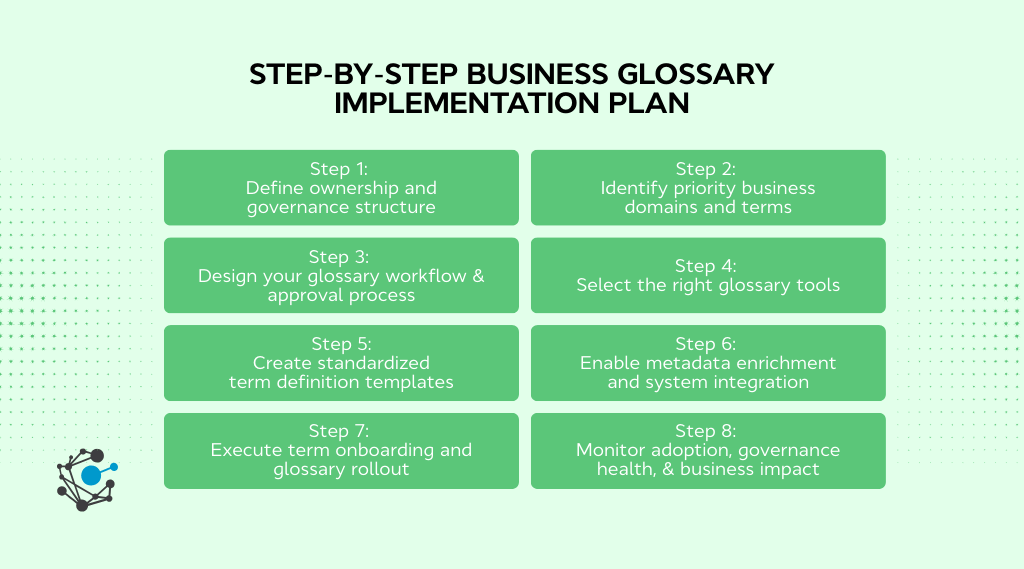
Implementing a business glossary across an enterprise requires more than defining a list of business terms. The following framework outlines a practical step-by-step business glossary implementation plan used by many data governance programs.
Step 1: Define ownership and governance structure
The first step in a glossary implementation plan is establishing the governance structure responsible for managing terminology across the organization. Without clear ownership, glossary initiatives often struggle with inconsistent definitions, delayed approvals, and lack of accountability.
This step focuses on defining the roles and decision-making authority required to manage glossary terms throughout their lifecycle.
Key activities include:
-
Identifying an executive sponsor responsible for governance oversight
-
Appointing data owners accountable for domain-level definitions
-
Assigning business stewards responsible for maintaining glossary terms
-
Defining the glossary administrator role that manages platform operations
-
Establishing a data governance council to resolve definition conflicts
-
Creating a RACI model that clarifies responsibilities for glossary workflows
-
Defining approval authority for publishing and updating business terms
Clear governance ownership ensures that glossary definitions are maintained consistently and that changes follow a structured approval process.
A simple RACI model can help clarify responsibilities across stakeholders involved in glossary management.
|
Activity |
Responsible |
Accountable |
Consulted |
Informed |
|
Term creation |
Business steward |
Data owner |
Domain experts |
Governance council |
|
Term approval |
Data owner |
Governance council |
Analysts |
Business teams |
|
Term updates |
Business steward |
Data owner |
Technical steward |
Stakeholders |
|
Term retirement |
Governance admin |
Governance council |
Domain owners |
Business users |
Step 2: Identify priority business domains and terms
Attempting to document every business term across the enterprise at the beginning of a glossary initiative often leads to stalled projects and governance fatigue. Successful implementations typically start with high-impact business domains that influence reporting, analytics, and decision-making.
This step focuses on identifying the most important terms that should be standardized first.
Common prioritization approaches include:
-
Selecting core business domains such as revenue, customer, product, finance, or operations
-
Identifying cross-functional KPIs used across multiple departments
-
Prioritizing metrics used in executive reporting and strategic dashboards
-
Including regulatory or compliance-driven definitions required for reporting
-
Identifying frequently disputed metrics that create reporting conflicts
Organizations often create a tiered prioritization model to structure glossary rollout.
Example prioritization framework:
|
Tier |
Term type |
Examples |
|
Tier 1 |
Enterprise KPIs |
Revenue, customer churn, gross margin |
|
Tier 2 |
Domain metrics |
Marketing conversion rate, support resolution time |
|
Tier 3 |
Operational terms |
Internal workflow metrics or team-specific definitions |
Starting with high-impact metrics helps governance teams demonstrate value quickly while avoiding the complexity of enterprise-wide documentation at the early stages.
Step 3: Design your glossary workflow and approval process
After identifying priority terms, organizations must define how glossary entries are created, reviewed, approved, and maintained. A structured workflow ensures that definitions remain consistent and that updates follow governance policies.
Without a defined workflow, glossary terms can become outdated or conflicting versions may appear across systems.
A typical glossary governance workflow includes:
-
Term submission by business users or data stewards
-
Review and validation by domain experts
-
Approval by data owners or governance council members
-
Publication within the glossary platform or data catalog
-
Monitoring and periodic review to maintain accuracy
Additional governance considerations include:
-
Service-level expectations for reviewing and approving new terms
-
Version control for tracking definition changes
-
Conflict resolution processes for competing definitions
-
Guidelines for updating or retiring obsolete terms
|
A simple workflow structure often looks like this: Submit → Review → Approve → Publish → Monitor |
This process ensures that glossary definitions follow a consistent lifecycle rather than being added informally without governance oversight.
Step 4: Select the right glossary tools
Technology plays an important role in enabling scalable glossary governance. While early glossary initiatives often begin with spreadsheets or documentation platforms, these approaches become difficult to maintain as the number of business terms, datasets, and reporting systems grows.
At enterprise scale, glossary governance requires automation, structured workflows, and integration with data platforms. Specialized glossary or metadata management tools help automate term management, connect definitions with datasets and dashboards, and maintain traceability as data pipelines evolve.
Selecting the right platform helps organizations maintain governance processes while integrating glossary definitions with the broader data ecosystem.
Key capabilities to evaluate include:
-
Integrated glossary and data catalog functionality
-
Workflow automation for term review and approval
-
Role-based access control for contributors and stewards
-
Metadata tagging and classification features
-
Integration with data platforms and analytics systems
-
API capabilities for metadata synchronization
-
Scalability to support enterprise datasets and users
-
Lineage integration to connect terms with data pipelines and transformations
Many organizations choose platforms that combine glossary management with metadata catalog capabilities. This allows business terms to be directly connected with datasets, dashboards, and lineage information.
Once governance foundations and tooling are in place, the implementation process moves into the most operational stage: connecting business definitions to technical data assets.
Step 5: Map business terms to physical data assets
Once governance structures and glossary tools are in place, the next step is to connect business definitions to the data assets that produce those metrics. This step connects glossary definitions to the datasets and reports that produce those metrics.
Key activities in this step include:
-
Linking glossary terms to datasets and database tables
-
Associating terms with dashboards, reports, and analytics models
-
Identifying source systems that generate the data behind a metric
-
Connecting glossary terms to metadata catalog entries
-
Maintaining mappings as data pipelines evolve and schemas change
When these relationships are established, analysts can trace a business metric from its definition to the data sources and reports that use it. This connection improves trust in analytics and reduces confusion around how metrics are generated.
However, this stage introduces significant operational complexity.
Step 6: Capture transformation logic against business terms
After connecting glossary terms with datasets, organizations must document how those metrics are calculated as data moves through pipelines. This step links glossary definitions with the transformation logic that produces analytics metrics.
Capturing this logic helps stakeholders understand how raw data is processed before appearing in reports and dashboards.
Activities in this step typically include:
-
Documenting SQL transformation logic used in ETL or ELT pipelines
-
Mapping derived metrics created through aggregations or calculations
-
Linking glossary terms with data lineage relationships
-
Recording aggregation rules and formulas behind business KPIs
-
Updating transformation documentation as pipelines evolve
When transformation logic is connected to glossary definitions, users gain visibility into how a metric is produced across the data pipeline. This improves transparency and helps teams troubleshoot discrepancies more quickly.
|
Where most business glossary implementations slow down
The first stages of a glossary initiative are usually straightforward. Organizations define governance roles, select tools, and establish workflows for creating and approving business terms. However, friction often appears when teams attempt to operationalize the glossary. Steps five and six introduce continuous governance work that involves:
These tasks require collaboration between business stewards, analysts, and data engineers. In traditional governance environments, much of this work is performed manually. Common challenges during this stage include:
Without automation support, these activities can slow glossary adoption and create governance bottlenecks. With this context in mind, the following sections walk through the eight core steps required to implement a scalable business glossary. |
Step 7: Execute term onboarding and glossary rollout
After governance foundations and technical mappings are established, organizations can begin introducing the glossary to business teams. This step focuses on driving adoption so that the glossary becomes part of everyday analytics and reporting workflows.
Successful rollout strategies emphasize communication, training, and integration with existing tools.
Common rollout activities include:
-
Creating a communication plan that explains glossary's purpose and benefits
-
Launching the glossary across priority business domains
-
Conducting training sessions for analysts, data stewards, and business users
-
Embedding glossary links within BI dashboards and reporting tools
-
Running department-level pilot programs before expanding enterprise-wide
-
Encouraging analysts to reference glossary definitions during reporting development
Many organizations adopt a phased rollout approach, starting with one or two business domains before expanding across the enterprise. This approach allows governance teams to refine workflows and address adoption challenges early.
Example phased rollout model:
|
Phase |
Focus area |
|
Phase 1 |
Core enterprise KPIs and executive reporting metrics |
|
Phase 2 |
Domain-specific analytics, such as marketing, product, or operations |
|
Phase 3 |
Operational terms and extended analytics metrics |
Gradual rollout helps organizations build trust in the glossary while refining governance processes.
Step 8: Monitor adoption, governance health, and business impact
Business glossary implementation does not end after deployment. Continuous monitoring ensures that definitions remain accurate, governance processes function properly, and adoption continues to grow.
Organizations should establish metrics that track both governance performance and business value.
Common monitoring activities include:
-
Tracking glossary usage analytics and search activity
-
Measuring approval cycle time for new or updated terms
-
Monitoring definition revisions and updates
-
Evaluating data steward participation levels
-
Identifying adoption gaps across departments
-
Reviewing governance compliance with glossary policies
These insights help governance teams identify areas where definitions require clarification, workflows need improvement, or additional training is necessary.
Over time, monitoring adoption and governance health ensures that the business glossary remains an active component of the enterprise data ecosystem rather than a static documentation asset.
Business glossary governance operating model
After the initial implementation, organizations need a governance structure that ensures the glossary continues to evolve with the business and the underlying data systems. A business glossary governance operating model defines how glossary management functions on an ongoing basis, including ownership, lifecycle management, and change control.
This section focuses on day-to-day governance operations that maintain glossary accuracy after the initial rollout. While implementation establishes the glossary and deployment strategies expand it across the enterprise, the operating model ensures that definitions remain current, approved, and aligned with evolving data systems.
Without an operating model, glossary initiatives often lose momentum after launch. Definitions become outdated, stewardship responsibilities become unclear, and governance workflows slow down. A structured operating model prevents these issues by establishing clear roles, repeatable processes, and accountability for maintaining business terminology.
Key roles in business glossary management
Successful glossary governance depends on clearly defined responsibilities across both business and technical teams. Each role contributes to maintaining accurate definitions and ensuring that glossary workflows operate smoothly.
Common roles in a glossary governance structure include:
-
Data owners: Senior stakeholders responsible for approving definitions and ensuring terminology aligns with business policies.
-
Business stewards: Domain experts who create, maintain, and review glossary terms. They act as the primary custodians of business definitions.
-
Technical stewards: Data engineers or architects who help connect glossary terms with datasets, lineage information, and technical metadata.
-
Governance council: A cross-functional group that resolves definition conflicts, establishes standards, and oversees governance policies.
-
IT administrators: Platform administrators who manage glossary tools, access permissions, integrations, and technical configurations.
This collaborative structure ensures that glossary governance balances business ownership with technical oversight.
Glossary lifecycle management framework
A structured lifecycle ensures that glossary terms remain accurate and aligned with evolving business processes. Lifecycle management defines how terms move from initial creation to retirement while maintaining governance controls.
A typical glossary lifecycle includes the following stages:
-
Term creation: A business steward proposes a new term or KPI definition.
-
Validation: Domain experts review the proposed definition for accuracy and alignment with existing terminology.
-
Approval: Data owners or governance authorities approve the term for publication.
-
Publication: The approved definition becomes visible within the glossary platform or data catalog.
-
Periodic review: Stewards periodically review terms to ensure definitions remain accurate as business processes evolve.
-
Retirement: Outdated or obsolete terms are archived or retired to prevent confusion.
Lifecycle management prevents glossary definitions from becoming outdated and ensures that governance policies remain enforceable over time.
Version control and change management strategy
Business terminology changes as organizations evolve, launch new products, or modify reporting frameworks. Without proper change management, these updates can lead to confusion or conflicting definitions.
A structured version control and change management strategy helps governance teams track updates while preserving historical context.
Key practices include:
-
Maintaining audit logs for all glossary changes
-
Tracking definition revisions and version history
-
Recording approval decisions associated with term updates
-
Managing conflicting definitions through governance workflows
-
Supporting organizational changes such as mergers, acquisitions, or restructuring
These practices ensure that glossary updates remain transparent and traceable, which is especially important for regulatory reporting and audit readiness.
When combined with governance roles and lifecycle management processes, change management allows the business glossary to remain accurate, trustworthy, and aligned with evolving enterprise data environments.
Glossary deployment strategies for enterprise scale
After the glossary foundation and operating model are established, organizations must determine how to scale the implementation across business units, geographies, and data systems. Enterprise environments often contain hundreds of teams, analytics platforms, and reporting workflows, making structured deployment strategies essential.
Successful enterprise deployments typically rely on phased expansion, domain-driven ownership, and integration with existing data governance platforms.
Phased rollout vs big-bang deployment
Organizations usually adopt one of two rollout approaches when deploying a business glossary across the enterprise.
A phased rollout introduces glossary governance gradually, starting with a limited set of domains or high-impact metrics before expanding across the organization. A big-bang deployment, on the other hand, attempts to launch the glossary across multiple domains simultaneously.
|
Deployment approach |
Characteristics |
Advantages |
Risks |
|
Phased rollout |
Incremental expansion across domains |
Easier change management, faster early adoption |
Slower enterprise coverage |
|
Big-bang deployment |
Large-scale launch across many teams |
Rapid enterprise visibility |
Higher coordination complexity and governance risk |
Most organizations choose a phased rollout because it allows governance teams to refine workflows, resolve conflicts, and build stakeholder trust before scaling glossary coverage.
A typical phased approach may start with finance or revenue metrics, then expand into customer analytics, marketing metrics, and operational reporting.
Scaling glossary implementation across business units
As glossary adoption grows, organizations must ensure that governance processes remain manageable across multiple business units and domains. A domain-driven governance model often works best for enterprise environments.
In this model:
-
Each domain maintains ownership of its domain-specific terms
-
Enterprise governance teams maintain global standards and policies
-
Cross-domain metrics follow centralized approval processes
Key practices for scaling glossary governance include:
-
Assigning domain stewards responsible for maintaining terminology within their areas
-
Establishing shared standards for naming conventions and definitions
-
Maintaining centralized governance oversight to prevent conflicting definitions
-
Creating processes for resolving cross-domain terminology conflicts
This structure allows organizations to scale glossary adoption while maintaining enterprise-level consistency.
Integrating glossary with data catalogs and governance platforms
To achieve enterprise-scale impact, the business glossary should be integrated with the broader metadata and governance ecosystem. Integration ensures that glossary definitions are accessible wherever data is used.
Common integration patterns include:
-
Linking glossary terms to datasets, tables, and dashboards within data catalogs
-
Connecting glossary definitions with data lineage and pipeline metadata
-
Synchronizing glossary terms with metadata management platforms through APIs
-
Embedding glossary context directly into BI tools and analytics environments
-
Aligning glossary governance workflows with data quality and compliance frameworks
When these integrations are implemented, the glossary becomes a central reference layer for the enterprise data ecosystem. Analysts, engineers, and business stakeholders can access consistent definitions directly within the tools they use for reporting, analytics, and data management.
Common challenges when you implement a business glossary (and how to solve them)
Even with a structured implementation plan, organizations often encounter challenges when deploying a business glossary. Most issues are not technical but organizational. They typically involve unclear ownership, low adoption, conflicting definitions, and governance bottlenecks. Addressing these challenges early helps ensure glossary initiatives remain sustainable and useful for business teams.
8eff.png)
Lack of stakeholder alignment
Glossary initiatives often struggle when business and technical teams are not aligned on terminology governance. Common issues include:
-
Limited executive sponsorship for governance initiatives
-
Departments resisting the standardization of their metrics
-
Unclear ownership for glossary terms
To address this:
-
Secure executive sponsorship
-
Establish a governance council with cross-domain representation
-
Assign data owners and business stewards for domain terms
Strong governance leadership helps resolve conflicts and maintain consistency.
Low glossary adoption
A glossary has little value if teams do not use it. Adoption problems usually occur when the glossary is disconnected from everyday analytics workflows. Ways to improve adoption:
-
Embed glossary definitions in BI dashboards and reports
-
Integrate the glossary with data catalogs and analytics tools
-
Provide training for analysts and business teams
Inconsistent definitions across departments
Different teams often define the same metric differently, leading to reporting conflicts. Mitigation strategies include:
-
Maintaining authoritative definitions for enterprise KPIs
-
Using governance councils to resolve definition conflicts
-
Tracking version history for term updates
Manual workflows and governance bottlenecks
Manual documentation and approval processes can slow glossary operations as the number of terms grows. Organizations can reduce bottlenecks by:
-
Automating metadata discovery and term-to-dataset mapping
-
Integrating glossary tools with lineage and catalog platforms
-
Monitoring governance workflows through operational metrics
Metrics to measure glossary implementation success
Measuring performance is essential to ensure a business glossary delivers governance value and remains actively used across the organization. Tracking the right metrics helps governance teams monitor adoption, evaluate workflow efficiency, and understand whether standardized definitions are improving analytics reliability.
Glossary success metrics typically fall into three categories: operational performance, governance participation, and business impact.
Operational metrics
Operational metrics measure how effectively glossary workflows are functioning. Examples include:
-
Number of terms created and approved
-
Approval cycle time for new terms
-
Percentage of terms with linked data assets
-
Review completion rates for glossary updates
These indicators help governance teams assess whether glossary processes are efficient and scalable.
Governance metrics
Governance metrics track participation and policy adherence across stakeholders. Common indicators include:
-
Data steward engagement levels
-
Participation in term review and approval workflows
-
Compliance with governance policies and standards
High governance participation usually indicates that glossary management responsibilities are clearly defined and actively maintained.
Business impact metrics
Business metrics help evaluate whether glossary adoption improves organizational data practices.
Key indicators may include:
-
Reduction in reporting discrepancies or metric disputes
-
Fewer data clarification requests from analysts or business users
-
Faster decision-making cycles due to consistent definitions
These metrics help organizations demonstrate that a business glossary contributes to stronger data governance and more reliable analytics.
|
Business glossary implementation checklist A business glossary implementation involves governance design, technical integration, and organizational adoption. The following checklist summarizes the key steps required to successfully implement and scale a glossary across the enterprise. Use this as a quick reference to validate whether the foundational elements of your glossary rollout are in place. Governance foundation
Glossary design and workflow
Technical integration
Rollout and adoption
Continuous governance
Completing these steps helps organizations ensure that their business glossary becomes an operational governance asset rather than a static documentation repository. |
Conclusion
A business glossary delivers value only when it becomes part of a structured governance program. Simply documenting definitions is not enough. Organizations must connect business terminology with governance, ownership, metadata systems, and the data assets that power analytics and reporting.
A clear business glossary implementation plan helps teams move from documentation to operational governance. By defining roles, prioritizing high-impact terms, establishing approval workflows, and linking definitions to datasets and lineage, organizations can maintain consistent terminology across dashboards, reports, and data platforms.
Equally important is treating glossary implementation as an ongoing governance operating model. Adoption improves when definitions are embedded in analytics tools, stewards maintain terminology, and governance teams continuously monitor usage and updates.
Platforms such as OvalEdge support this approach by combining business glossary management with data catalog, lineage, and governance workflows in a single environment. This integration helps organizations operationalize glossary governance and maintain consistent business definitions as their data ecosystems continue to evolve.
FAQs
1. How long does a business glossary implementation plan take?
Most organizations complete the initial phase of a business glossary implementation plan in 8–16 weeks. The timeline depends on governance maturity, the number of domains included in the first rollout, and the complexity of integrating glossary definitions with data catalogs, pipelines, and reporting tools.
2. Who should own a business glossary?
Business ownership should typically sit with domain leaders and business data stewards, since they understand the meaning and usage of key metrics. Technical teams support the implementation by linking glossary terms to datasets, lineage, and metadata systems. A governance council usually oversees policies and resolves definition conflicts.
3. How do you implement a business glossary successfully?
Successful implementation usually follows a structured approach:
-
Define governance roles and ownership
-
Identify priority business domains and KPIs
-
Design workflows for term creation and approval
-
Connect terms to datasets, dashboards, and lineage
-
Roll out the glossary across departments
-
Monitor adoption and governance performance
This approach ensures that glossary definitions become part of everyday analytics workflows.
4. What tools are needed for business glossary setup?
Organizations typically use business glossary tools or integrated data catalog platforms that support:
-
Governance workflows and approval processes
-
Metadata enrichment and dataset mapping
-
Role-based access controls
-
API integrations with data platforms
-
Lineage and governance tracking features
These capabilities help maintain consistent terminology across the data ecosystem.
5. How is a business glossary different from a data dictionary?
A business glossary defines business concepts, metrics, and terminology in language that business users understand. A data dictionary documents technical details such as database tables, columns, data types, and schema structures. Together, they provide both business context and technical metadata for enterprise data assets.
6. How do you ensure long-term glossary adoption?
Organizations improve long-term adoption by embedding glossary definitions directly into analytics workflows. Common practices include linking terms in BI dashboards, training analysts and business teams, automating governance workflows, and tracking usage metrics to monitor engagement across departments.
Deep-dive whitepapers on modern data governance and agentic analytics
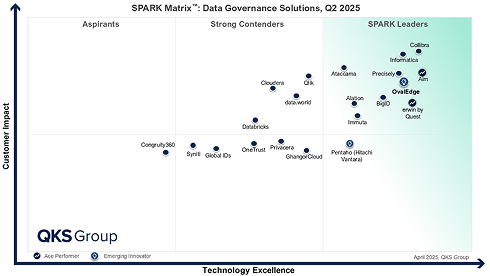
OvalEdge Recognized as a Leader in Data Governance Solutions
3ff1.png)
“Reference customers have repeatedly mentioned the great customer service they receive along with the support for their custom requirements, facilitating time to value. OvalEdge fits well with organizations prioritizing business user empowerment within their data governance strategy.”
aef2.png)
“Reference customers have repeatedly mentioned the great customer service they receive along with the support for their custom requirements, facilitating time to value. OvalEdge fits well with organizations prioritizing business user empowerment within their data governance strategy.”
Gartner, Magic Quadrant for Data and Analytics Governance Platforms, January 2025
Gartner does not endorse any vendor, product or service depicted in its research publications, and does not advise technology users to select only those vendors with the highest ratings or other designation. Gartner research publications consist of the opinions of Gartner’s research organization and should not be construed as statements of fact. Gartner disclaims all warranties, expressed or implied, with respect to this research, including any warranties of merchantability or fitness for a particular purpose.
GARTNER and MAGIC QUADRANT are registered trademarks of Gartner, Inc. and/or its affiliates in the U.S. and internationally and are used herein with permission. All rights reserved.