


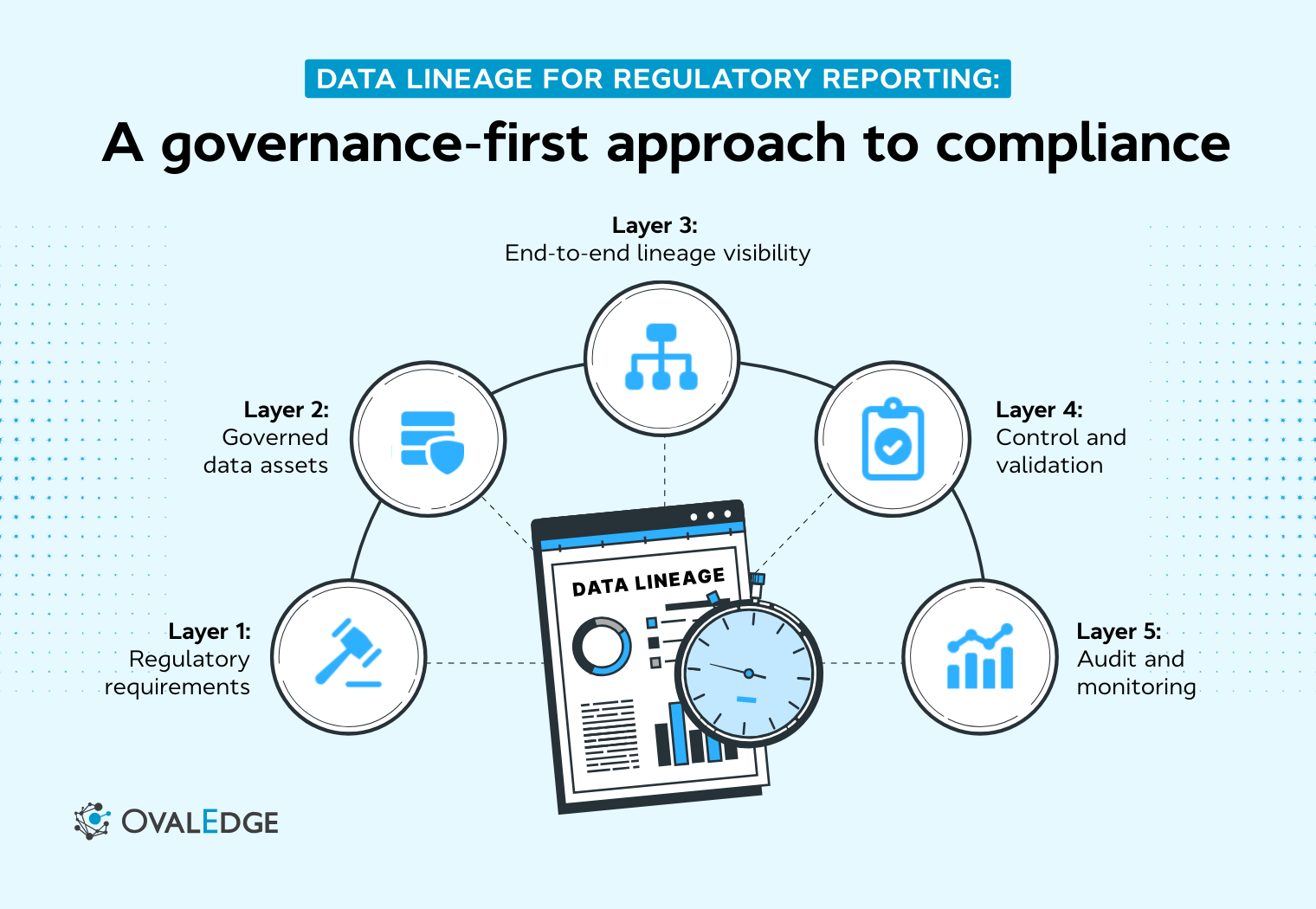
Regulatory reporting requires financial institutions to demonstrate complete transparency in how data is sourced, transformed, and reported. Data lineage enables organizations to trace every data element from its origin through transformations to final regulatory filings, ensuring audit-ready compliance. By mapping data flows across the regulatory reporting lifecycle, lineage platforms improve traceability, impact analysis, and regulatory auditability. Modern solutions automate metadata collection, provide column-level traceability, and connect technical lineage with governance controls. Implementing a regulatory data lineage platform helps institutions reduce audit risk, improve reporting accuracy, and streamline compliance processes.
Regulatory reporting has evolved far beyond a simple documentation exercise. For financial institutions, it’s no longer enough to just compile data into a report as regulatory bodies demand complete transparency.
Financial institutions must be able to prove exactly how every number in their regulatory submissions was sourced, transformed, and validated. This level of scrutiny means that manual traceability, often time-consuming and prone to error, no longer suffices.
This is where data lineage for regulatory reporting comes in. By tracing data from its origin to its final form in regulatory filings, data lineage ensures that financial institutions can provide detailed, defensible evidence of their compliance efforts.
It reduces audit exposure, strengthens reporting accuracy, and ensures that organizations can quickly respond to regulatory reviews.
In this blog, we’ll explore how data lineage platforms not only enhance compliance but also automate the process of tracking and validating data, making audit preparation more efficient and less prone to human error. Let’s dive into why data lineage for regulatory reporting is a game-changer in today’s complex compliance environment.
What is data lineage for regulatory reporting, and why does it matter
Data lineage for regulatory reporting refers to the ability to trace the journey of data from its original source through various transformations to its final destination in regulatory and financial reports. It’s the process of documenting every step of this data flow, allowing institutions to show exactly where each data element came from, how it was changed, and how it supports the final report.
In regulatory reporting, the stakes are high.
Regulators require that organizations demonstrate transparency and accountability in their reporting processes. Data lineage ensures that every number in a regulatory filing is traceable, auditable, and defensible. This is crucial in frameworks like BCBS 239, SOX, and GDPR, where compliance requirements demand clear documentation of data movements, transformations, and validation.
Unlike general analytics lineage, regulatory compliance data lineage has some distinct features:
-
Preserves Historical Versions: Regulatory reports often need to show data from specific time periods. Lineage platforms must maintain historical versions of data, ensuring that institutions can prove their compliance over time.
-
Supports Column-Level Traceability: Institutions need to trace individual fields in reports back to the exact data elements they were derived from. Column-level lineage provides the granularity required for financial and regulatory reporting.
-
Provides Audit-Ready Exports: During audits, financial institutions must be able to generate comprehensive, structured reports that clearly show how data was derived and transformed. This includes not just the data itself but also the underlying transformation logic.
-
Reproduces Transformation Logic: Institutions must be able to replicate calculations and transformations, ensuring that the same process can be followed and verified if needed.
By implementing data lineage for regulatory reporting, organizations can significantly reduce their audit risk, increase transparency, and ensure compliance with increasingly stringent regulatory requirements.
Regulatory reporting lifecycle and where lineage platforms fit
Regulatory reporting doesn’t happen in a vacuum. It’s a complex process that moves through several stages, each of which introduces potential risks if traceability breaks down. Understanding the lifecycle of regulatory reporting and where data lineage platforms fit into this process is key to managing compliance effectively.
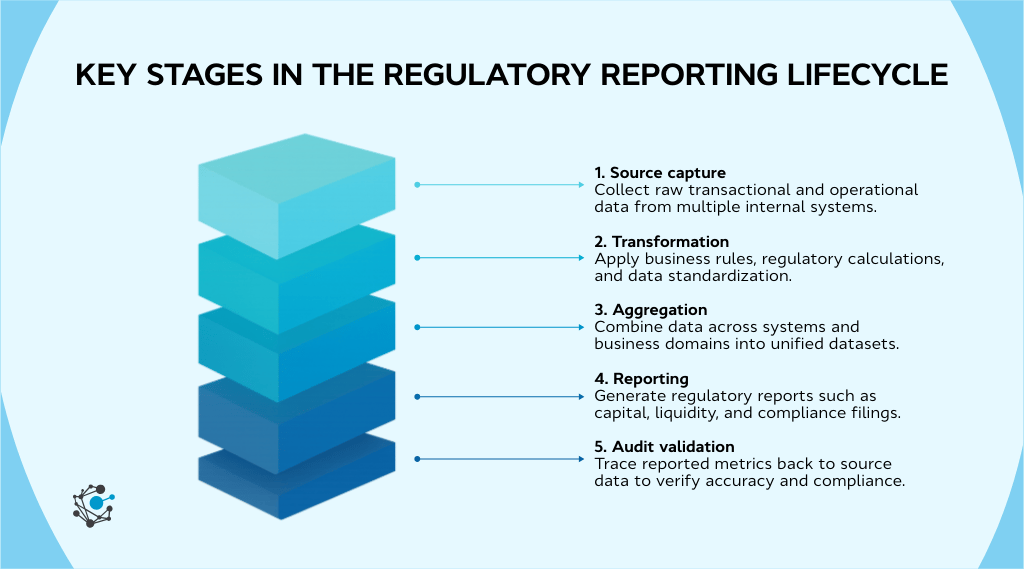
Key stages in the regulatory reporting lifecycle
-
Source Capture: The first step involves ingesting transactional and operational data from multiple systems. This data is often raw and unprocessed, so accurate capture is critical to ensure that everything required for compliance is gathered from the start.
-
Transformation: In this stage, business rules and risk calculations are applied to the raw data. Data transformations can include aggregation, currency conversion, or applying financial regulations. These transformations need to be precisely documented, as they form the basis of the final regulatory report.
-
Aggregation: Data is consolidated from various sources and domains. This stage ensures that all relevant data points are included, so institutions can create complete, accurate reports that reflect their full regulatory exposure.
-
Reporting: At this stage, capital, liquidity, and compliance reports are generated based on the aggregated data. These reports are submitted to regulatory bodies and serve as proof of the institution's adherence to relevant regulations.
-
Audit Validation: Finally, the data and reports are subject to audit. During this phase, institutions must be able to reproduce calculations and trace every data point back to its original source to verify that it meets the required standards of compliance.
Where data lineage platforms fit
A robust data lineage platform tracks metadata, transformation logic, ownership, and downstream dependencies across these stages. It connects technical lineage (i.e., the data’s journey through systems and transformations) with compliance reporting controls (i.e., the required regulatory validations).
By mapping data lineage across the entire reporting lifecycle, lineage platforms help ensure that every transformation, aggregation, and report generation step is traceable and transparent. This is essential for demonstrating audit readiness and complying with regulatory scrutiny.
Why this matters
Without automated, end-to-end traceability, financial institutions cannot fully demonstrate compliance. The lack of visibility into data transformations and aggregation exposes institutions to audit risks and potentially costly errors. With a regulatory lineage platform in place, institutions can ensure that they are always prepared for audit reviews, reducing risk and improving compliance efficiency.
Best data lineage solutions for regulatory reporting
When selecting a data lineage solution for regulatory reporting, it’s important to evaluate platforms based on their specific capabilities, regulatory focus, and fit for your organization’s needs.
Below, we’ve compared some of the leading solutions available for regulatory compliance, highlighting their strengths and ideal use cases.
1. OvalEdge
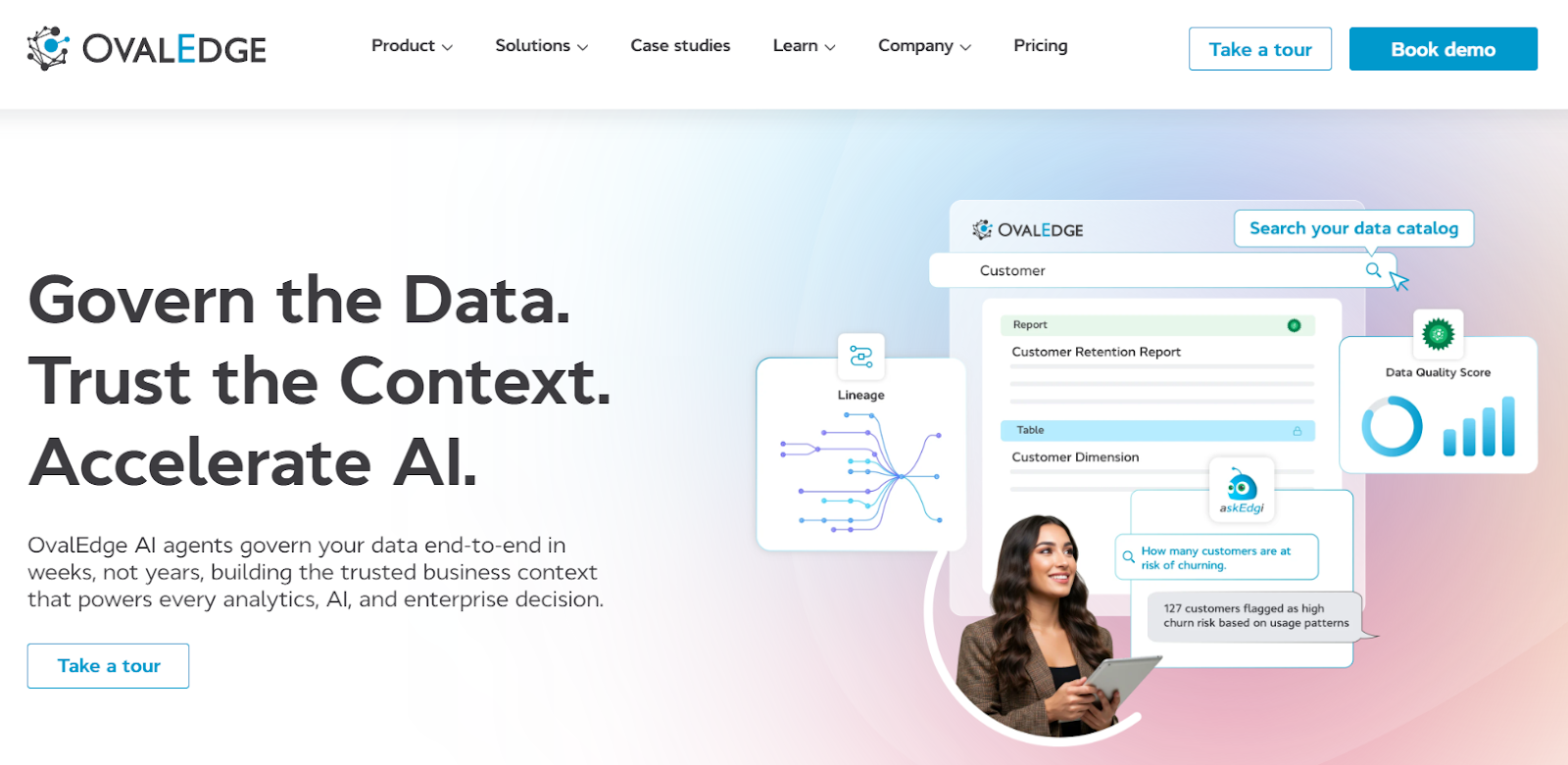
OvalEdge is a unified data governance and catalog platform that connects metadata management, automated lineage, data quality, business glossary, and compliance capabilities in one solution. It’s designed to simplify complex data environments by giving teams end‑to‑end visibility into data flows and governance workflows.
Key features
-
Automated data lineage: OvalEdge builds data lineage diagrams across data systems and pipelines automatically, helping organizations visualize the journey of data from source to report. This automated source‑to‑destination mapping supports more efficient root‑cause analysis and audit traceability.
-
Column‑level traceability and metadata context: The platform parses code, SQL, and BI tool logic to capture lineage down to the column level. Linking this technical lineage with business glossary terms and metadata enriches traceability for financial and regulatory reporting.
-
Integrated governance and compliance controls: OvalEdge layers lineage with governance workflows, policy enforcement, and data stewardship capabilities. This helps teams assign ownership, define controls, and align technical lineage with compliance requirements.
-
Impact analysis and audit readiness: Users can visualize upstream and downstream dependencies to assess the impact of changes before they affect regulatory reports. Historical lineage and audit trails streamline evidence gathering for compliance reviews.
-
Bird's eye view of data flow: With just one click, OvalEdge gives users a bird’s-eye view of the data flow between various applications, data warehouses, and reporting systems. This intuitive interface simplifies complex data environments, providing a clear, high-level understanding of data movement.
-
Extensive connector support: OvalEdge offers over 150 connectors, covering data platforms, ETLs, BI tools, applications, and streaming platforms. This wide-ranging compatibility ensures that data lineage is captured across diverse systems, providing a unified view of data flows across your organization.
-
Data quality & privacy management: OvalEdge includes integrated data quality and privacy features, ensuring that data is not only traceable but also compliant with privacy regulations. This allows organizations to maintain both the integrity and security of their data, ensuring it meets regulatory standards.
Pros:
-
Strong integration across catalog, lineage, and governance functions provides a single pane of truth for regulatory traceability and audit readiness.
-
Automated lineage generation reduces manual effort and accelerates compliance documentation.
-
Metadata and glossary integration help contextualize lineage for business and compliance stakeholders.
Best fit: OvalEdge is ideal for regulated enterprises that need a governance‑led regulatory lineage solution with strong automated lineage, metadata enrichment, and compliance controls. It suits organizations looking to centralize traceability, reduce audit prep time, and align technical lineage with policy and business context.
See OvalEdge in action and learn how our platform can improve your audit readiness. Book a personalized demo now.
2. Informatica
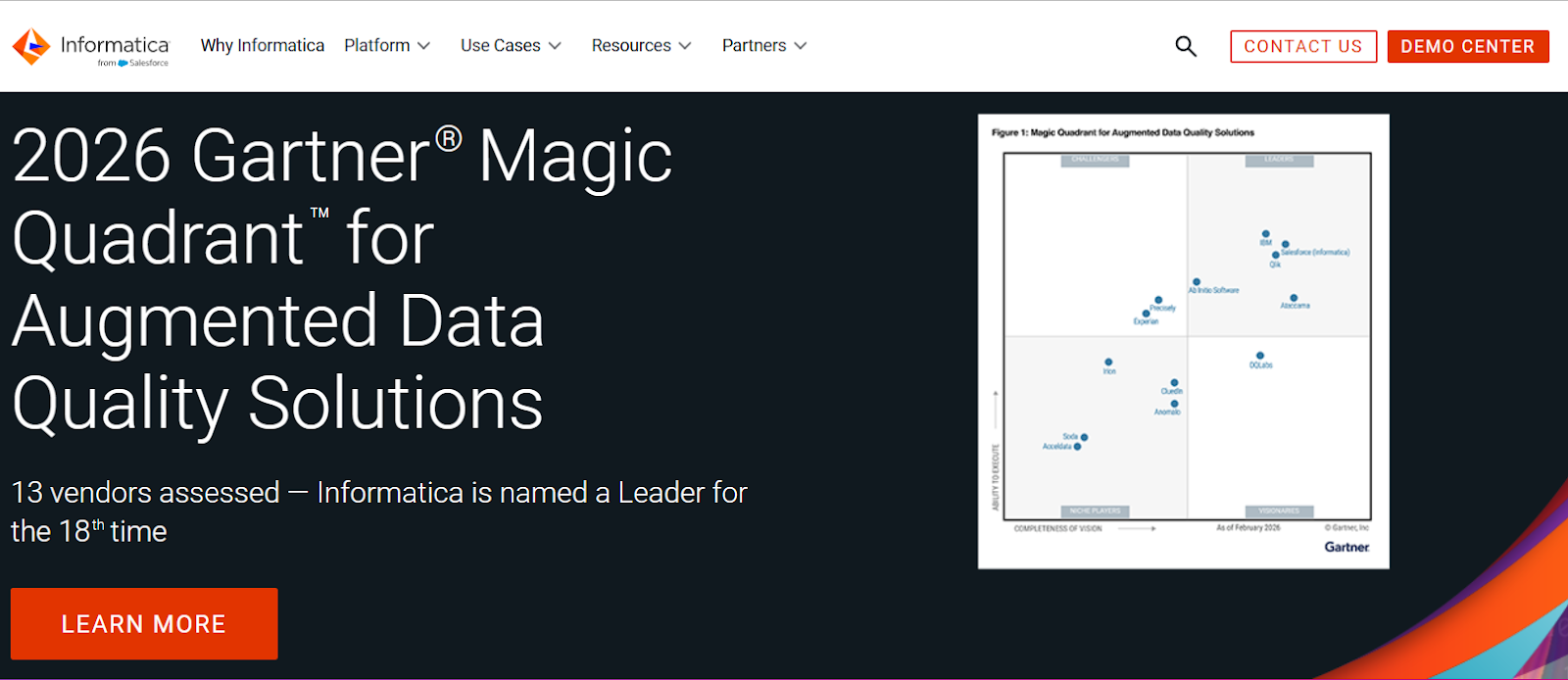
Informatica is a leading provider of cloud data integration and governance solutions. It excels in managing and integrating data across various systems, making it an excellent choice for financial institutions needing to comply with complex regulatory requirements like BCBS 239.
Key features
-
Data integration and automation: provides tools for integrating data from multiple sources, automating the data pipeline, and ensuring that data remains accurate and consistent throughout its lifecycle.
-
Column-level data lineage: Provides column-level traceability, allowing organizations to map data transformations at the most granular level.
-
Governance and compliance capabilities: Informatica’s suite includes data governance and policy enforcement tools that help organizations map data lineage against regulatory frameworks.
Pros:
- Comprehensive platform that integrates data across cloud and on-premise environments.
- Strong support for column-level data lineage, critical for financial and risk reporting.
- Mature compliance ecosystem, making it suitable for large enterprises with complex data needs.
Cons:
-
Can be complex to implement, particularly in highly customized environments.
-
Higher cost compared to some other solutions, making it more suited for large organizations with significant compliance needs.
Best Fit: large, complex enterprises that require robust governance and column-level lineage for risk and capital reporting.
3. Collibra
Collibra is a comprehensive data governance platform that helps organizations manage their data governance, privacy, and compliance needs. Its governance workflows enable organizations to integrate data management processes with compliance requirements efficiently.
Key Features
-
Enterprise Governance Workflows: Offers governance workflows to align data management processes with regulatory compliance needs.
-
Strong Policy Enforcement: integrates compliance policies directly into its data governance model.
-
Structured Data Stewardship: With built-in stewardship capabilities, Collibra helps organizations define ownership, track data quality, and establish accountability.
Pros:
-
Well-suited for large enterprises with complex governance needs.
-
Offers strong policy enforcement, ensuring alignment with compliance frameworks.
-
Comprehensive stewardship capabilities ensure accountability and data quality.
Cons:
-
Can be more difficult to set up initially due to its wide array of features.
-
May require customization to integrate fully with existing data ecosystems in some enterprises.
Best Fit: Collibra is ideal for large enterprises that are expanding their governance processes into regulatory traceability, particularly for SOX compliance.
4. Atlan
Atlan is a cloud-native data collaboration platform designed for modern data teams. It integrates data governance, lineage, and workflows in a flexible, cloud-first environment, making it ideal for organizations that rely on cloud technologies for their financial data management.
Key Features
-
Cloud-native architecture: Seamlessly integrates with cloud data platforms like AWS, Google Cloud, and Azure.
-
Collaborative workspace: Enables teams to collaborate on metadata, track changes, and manage data governance in real time.
-
Moderate compliance features: Supports essential data lineage and governance but lacks a deep regulatory focus compared to other tools.
Pros:
-
Ideal for cloud-native teams needing flexibility and collaboration.
-
Scalable and integrates well with cloud ecosystems.
Cons:
-
Limited compliance depth for complex regulatory requirements.
-
May require additional integrations for full regulatory coverage.
Best Fit: Atlan is best for cloud-first financial institutions that prioritize collaboration and flexibility but have moderate compliance needs.
5. Alation
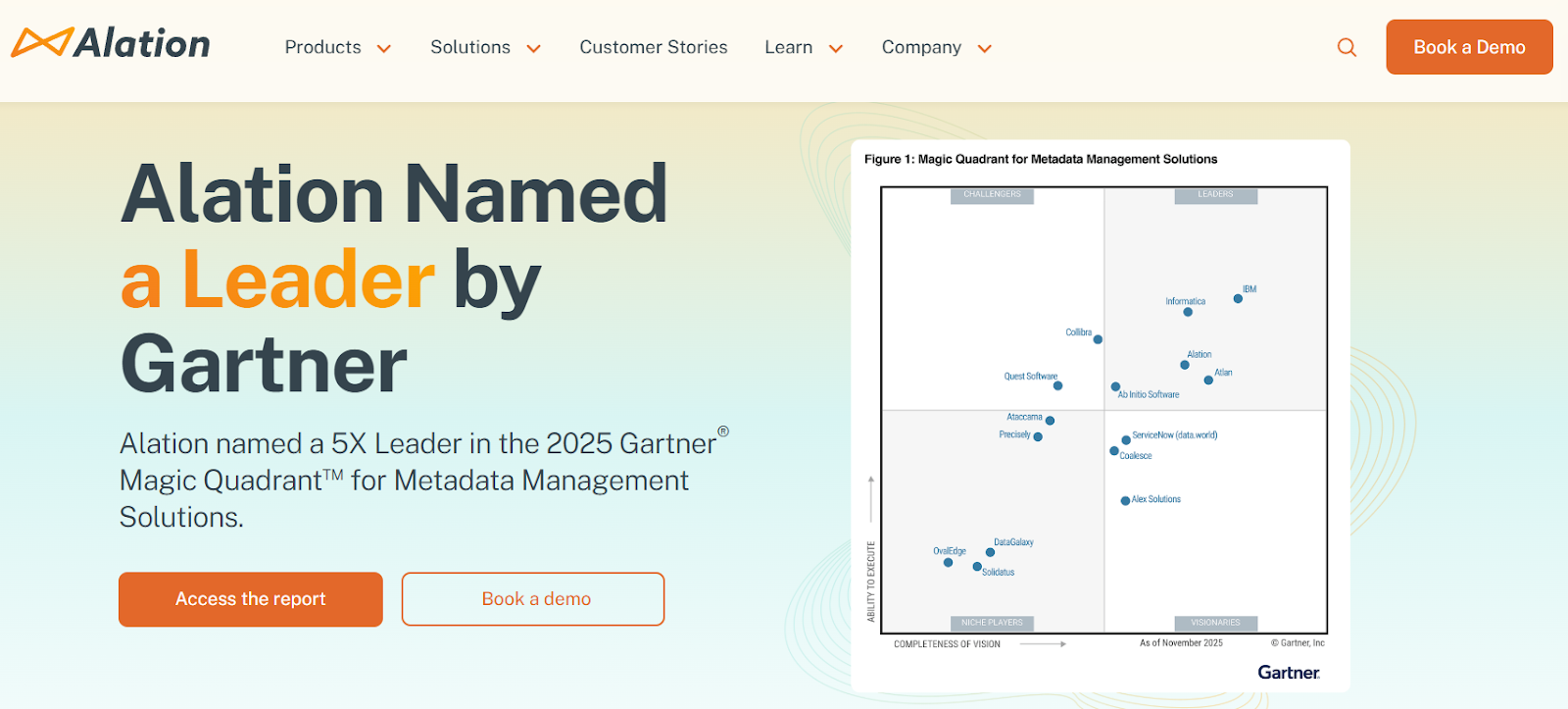
Alation is a data cataloging and governance platform designed to help organizations organize and understand their data. With its strong focus on data discovery and business intelligence, Alation empowers teams to find, trust, and govern data.
Key Features
-
Data discovery and cataloging: Provides a powerful search and discovery layer to help users find relevant data across various cloud and on-premise systems.
-
Business intelligence integration: Seamlessly integrates with BI tools, helping financial institutions connect analytics with governance and lineage.
-
Moderate compliance capabilities: Includes data governance and lineage features but is more focused on enabling data discovery rather than in-depth regulatory compliance.
Pros:
-
Strong search and discovery features for efficient data access.
-
Integrates well with BI tools, enabling better decision-making.
Cons:
-
Lacks deep regulatory compliance features needed for complex reporting.
- Primarily focused on discovery rather than governance or compliance.
Best Fit: Alation is ideal for cloud-first financial institutions that need to enhance data discovery and business intelligence integration, but with moderate compliance needs.
Key capabilities required for audit-ready data lineage
When it comes to regulatory reporting, having audit-ready data lineage is essential to ensure compliance and minimize the risk of errors. To be truly audit-ready, a data lineage solution must provide end-to-end traceability, transparency, and the ability to reproduce data transformations as required by auditors and regulatory bodies.
Here are the key capabilities your data lineage solution should offer:
1. End-to-end source-to-report lineage
Audit-ready data lineage must cover every stage of the data lifecycle, from initial data capture through to reporting. This includes all transformations, aggregations, and validations that occur along the way, ensuring that every data element in a regulatory report can be traced back to its source.
2. Column-level traceability for financial reporting
For financial reporting compliance, it’s crucial to have visibility into each individual data field and how it’s been transformed. Column-level traceability ensures that each number or metric in a report can be traced directly to its source, including the specific calculation or business rule that was applied.
3. Automated metadata harvesting
An audit-ready solution should automatically collect and update metadata across various data systems. This includes databases, ETL tools, BI platforms, and data warehouses, reducing the manual effort required to maintain lineage and ensuring that your data reporting is always up to date.
4. Historical versioning and lineage snapshots
Regulatory reports often require that historical data be preserved and made accessible for audits. Data lineage solutions should be capable of capturing historical snapshots and maintaining versioning to provide a clear record of how data has evolved over time.
5. Regulatory report tagging and mapping
For compliance, the data lineage platform must be able to tag data elements and map them to the relevant regulatory requirements. This allows for seamless reporting and ensures that every data point aligns with the specific regulatory framework, whether that’s BCBS 239, SOX, or GDPR.
6. Impact analysis for regulatory changes
Changes to the data pipeline can have significant implications for regulatory reporting. An audit-ready data lineage platform should provide impact analysis, showing which data reports or elements may be affected by changes in the data systems or processes.
7. Audit-ready evidence export
The ability to generate clear, exportable audit reports is a must-have feature. The solution should allow users to easily produce evidence showing how data was sourced, transformed, and reported, enabling quicker response times during regulatory reviews or audits.
8. Role-based access and approval workflows
To ensure proper oversight and accountability, data lineage solutions should include role-based access controls and approval workflows. This ensures that sensitive data and transformations are only accessible to authorized personnel and that all changes to data systems are properly reviewed.
How to choose the right regulatory compliance data lineage solution
Choosing the right data lineage tools for regulatory compliance depends on your organization’s regulatory exposure, reporting complexity, and governance maturity. Here are some key factors to consider:
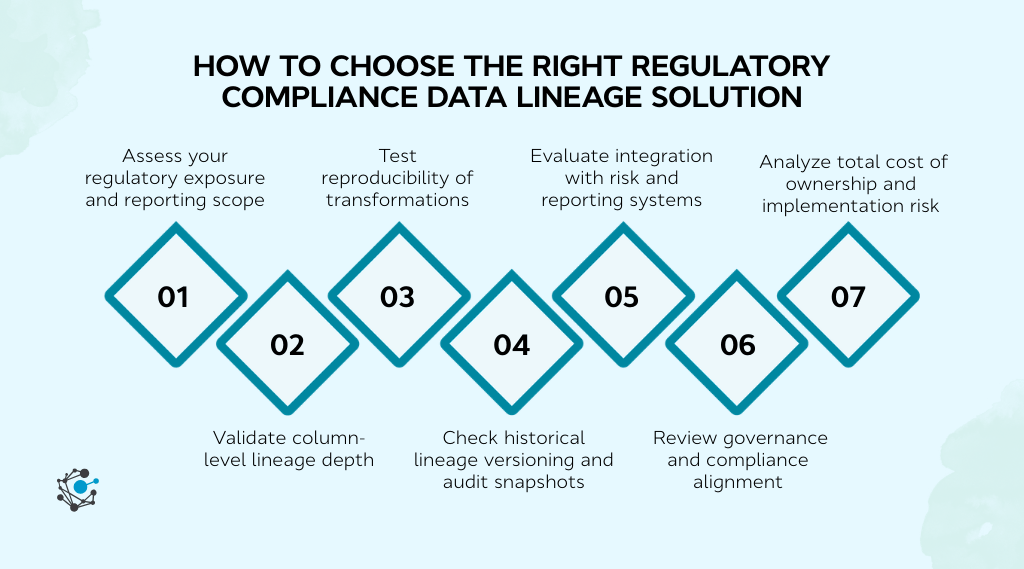
1. Assess your regulatory exposure and reporting scope
Understand which regulatory frameworks, such as BCBS 239, SOX, or GDPR, apply to your organization. Evaluate the number and complexity of the reports you need to generate, and identify critical data elements that need to be traceable for compliance.
Actionable Steps:
-
Review the regulatory frameworks applicable to your business, focusing on those that impact data governance.
-
Create an inventory of your regulatory reports and identify the most complex ones.
-
Determine the most critical data points in your reports that must be traceable to comply with regulations.
2. Validate column-level lineage depth
Ensure the solution supports column-level traceability, which is essential for financial and regulatory reporting. Test its ability to trace data from source systems down to individual report fields, ensuring precise compliance with regulatory standards.
Actionable Steps:
-
Request a demo from vendors that offer column-level lineage to see how deep their traceability goes.
-
Test the tool by selecting a sample report and confirming you can trace data at the column level.
-
Compare the depth of lineage across different platforms to ensure that critical data fields are included.
3. Test reproducibility of transformations
Your data lineage solution should allow you to recreate transformation logic during audits. Ensure it offers transparency into SQL, ETL, and calculation logic, and that lineage updates automatically after pipeline changes.
Actionable Steps:
-
Test the solution’s ability to reproduce transformations by simulating an audit scenario.
-
Verify that lineage is updated automatically after data pipeline changes, ensuring continuous accuracy.
-
Review the transparency of transformation logic and confirm access to SQL and ETL pipelines.
4. Check historical lineage versioning and audit snapshots
Regulatory reports may require the preservation of historical data and lineage. Confirm that the solution maintains versioning and lineage snapshots for lookback periods, and that these can be exported with time-stamped evidence.
Actionable Steps:
-
Ensure the solution supports versioning and that historical data can be captured.
-
Test the tool’s ability to generate snapshots and check if they can be exported with timestamps.
-
Ask the vendor for details on how they handle lookback periods for regulatory audits.
5. Evaluate integration with risk and reporting systems
Assess how well the solution integrates with your existing risk and reporting systems, such as core banking, ERPs, and BI platforms. Seamless integration ensures consistent data lineage across all systems.
Actionable Steps:
-
Identify all core risk and reporting systems that need integration with your data lineage solution.
-
Request integration documentation from the vendor and test with your existing systems.
-
Ensure that the tool can pull data from various sources without disrupting current processes.
6. Review governance and compliance alignment
Ensure the solution supports regulatory tagging, business glossary integration, and governance workflows to align data lineage with compliance controls.
Actionable Steps:
-
Assess whether the tool offers tagging and glossary integration for mapping data to compliance terms.
-
Review the governance workflows available to ensure they align with your organization's compliance processes.
-
Verify role-based access controls and ensure compliance workflows are automated for better governance.
7. Analyze total cost of ownership and implementation risk
Consider the cost of implementation, ongoing maintenance, and any customization needs. Compare this with the long-term benefits of risk reduction, audit readiness, and streamlined compliance processes.
Actionable Steps:
-
Request a detailed cost breakdown from the vendor, including implementation, maintenance, and customizations.
-
Conduct a risk assessment to identify potential issues with implementation and ongoing maintenance.
-
Calculate the ROI based on expected audit risk reduction and compliance improvements.
How regulatory reporting lineage works with OvalEdge
OvalEdge offers a comprehensive solution for managing regulatory reporting lineage, ensuring compliance and audit readiness. Here’s how it supports regulatory reporting lineage:
1. Automated source-to-report traceability
OvalEdge automates metadata collection across various systems, providing continuous updates on data lineage. With over 150 connectors, it ensures end-to-end traceability from source systems to final regulatory reports, reducing manual work and minimizing errors.
2. Column-level lineage
OvalEdge offers column-level traceability, capturing detailed data transformations, including business rules and calculations. This level of granularity ensures that every data field in regulatory reports is traceable to its original source, critical for financial compliance.
3. Integrated governance and compliance alignment
OvalEdge combines data governance with lineage by linking business glossaries, policy enforcement, and data stewardship workflows directly to data lineage. This helps align technical lineage with regulatory requirements, ensuring consistent and compliant data transformations.
4. Impact analysis and audit-ready evidence generation
OvalEdge’s impact analysis tool visualizes data dependencies, enabling users to assess the impact of changes across the data pipeline. It also generates exportable, audit-ready documentation, simplifying compliance checks and speeding up audit responses.
Conclusion
Regulatory reporting is increasingly complex, requiring organizations to demonstrate complete traceability from data sources to final reports. To meet compliance demands and minimize audit risk, financial institutions must adopt a data lineage solution that offers transparency, automation, and precision.
Solutions like OvalEdge provide the end-to-end lineage tracking needed for regulatory frameworks such as BCBS 239, SOX, and GDPR, ensuring that every transformation and aggregation is fully documented and auditable.
By automating data lineage, OvalEdge helps organizations streamline compliance processes, improve data governance, and reduce the manual effort involved in regulatory reporting. With capabilities like column-level traceability, impact analysis, and seamless integration with risk reporting systems, OvalEdge ensures that your data is always audit-ready.
If you're looking to take control of your regulatory compliance and reduce the risk of audit discrepancies, OvalEdge offers a comprehensive solution tailored to your needs.

Book a demo today to see how our platform can streamline your regulatory reporting and data governance processes.
FAQs
1. What is data lineage for regulatory reporting?
Data lineage for regulatory reporting enables organizations to trace data from its source to its final destination in regulatory reports. It ensures that every data point can be traced back to its origin, providing transparency and audit-ready evidence during compliance reviews or audits.
2. Why is column-level lineage important for financial reporting?
Column-level lineage is crucial for financial reporting because it allows institutions to trace individual report fields back to the exact data elements and transformation logic. This ensures that financial reports are accurate and compliant, and it helps prevent aggregation errors that could lead to regulatory issues.
3. How does data lineage support BCBS 239 compliance?
Data lineage supports BCBS 239 by enabling clear and transparent tracking of risk data aggregation and reporting. It helps organizations demonstrate the accuracy and integrity of risk metrics, providing a defensible audit trail that meets regulatory expectations for governance and reporting.
4. What is audit-ready data lineage?
Audit-ready data lineage is the ability to provide complete and reproducible traceability of data from its source to final regulatory reports, including transformation logic and historical versions. It ensures that institutions can quickly generate evidence for audits, reducing audit preparation time and strengthening compliance defensibility.
5. Can regulatory reporting automation replace manual audit documentation?
While automation reduces the reliance on manual documentation, it doesn’t entirely replace the need for oversight. Automation helps capture metadata and transformation logic, making the reporting process more efficient and error-free. However, human oversight is still essential for final compliance reviews.
6. How can data lineage improve audit response times?
Data lineage improves audit response times by providing a clear, organized view of how data moves through systems and is transformed. With an automated lineage solution, institutions can quickly generate the required documentation and trace any data discrepancies, allowing auditors to review evidence in real-time, speeding up the overall audit process.
Deep-dive whitepapers on modern data governance and agentic analytics
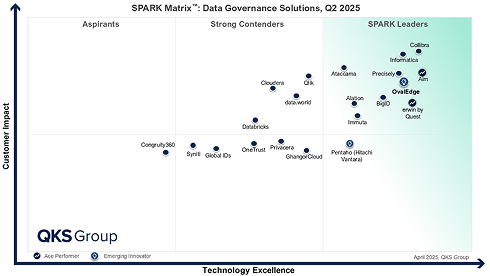
OvalEdge Recognized as a Leader in Data Governance Solutions
3ff1.png)
“Reference customers have repeatedly mentioned the great customer service they receive along with the support for their custom requirements, facilitating time to value. OvalEdge fits well with organizations prioritizing business user empowerment within their data governance strategy.”
aef2.png)
“Reference customers have repeatedly mentioned the great customer service they receive along with the support for their custom requirements, facilitating time to value. OvalEdge fits well with organizations prioritizing business user empowerment within their data governance strategy.”
Gartner, Magic Quadrant for Data and Analytics Governance Platforms, January 2025
Gartner does not endorse any vendor, product or service depicted in its research publications, and does not advise technology users to select only those vendors with the highest ratings or other designation. Gartner research publications consist of the opinions of Gartner’s research organization and should not be construed as statements of fact. Gartner disclaims all warranties, expressed or implied, with respect to this research, including any warranties of merchantability or fitness for a particular purpose.
GARTNER and MAGIC QUADRANT are registered trademarks of Gartner, Inc. and/or its affiliates in the U.S. and internationally and are used herein with permission. All rights reserved.