


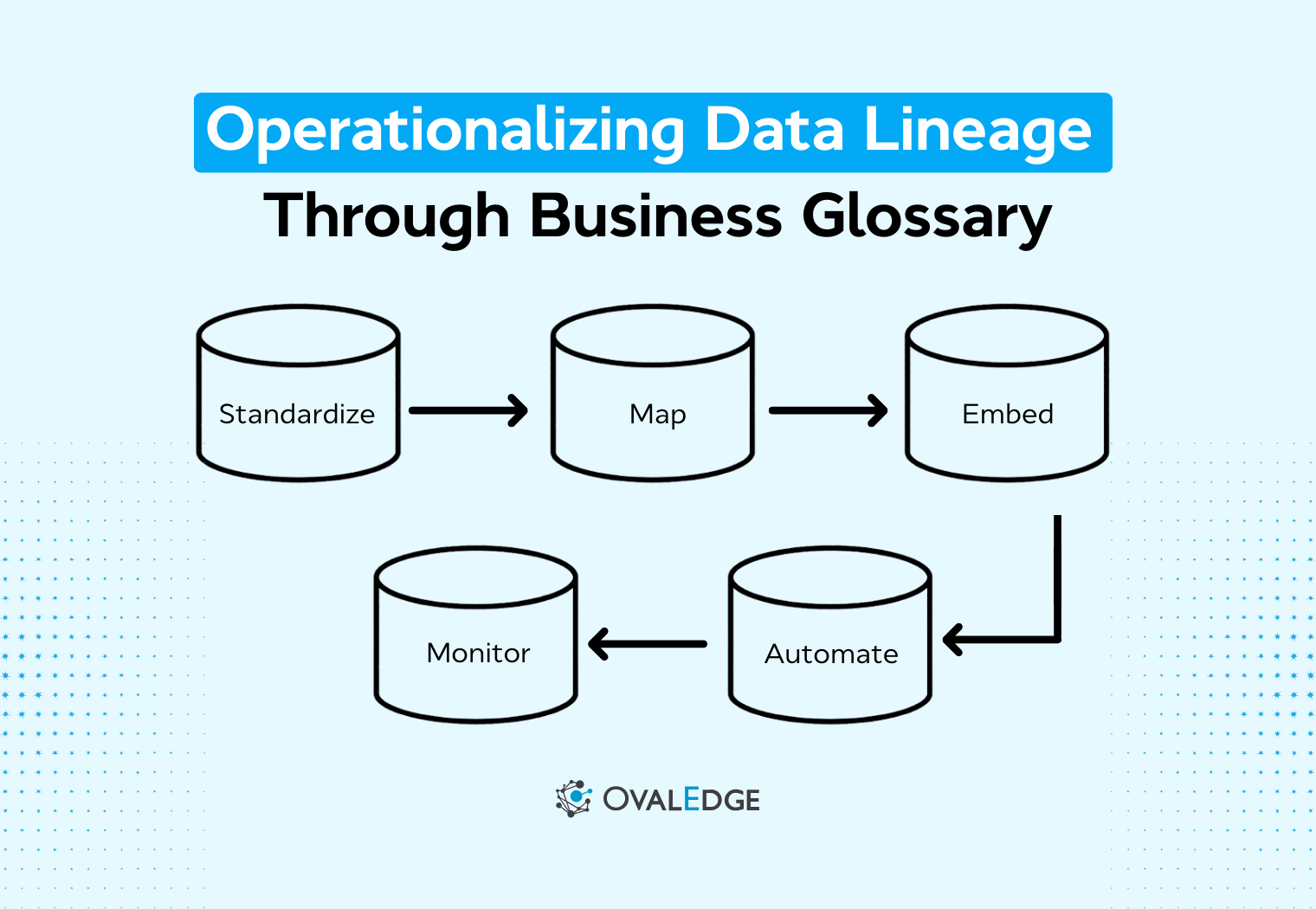
Static lineage diagrams offer visibility but limited operational value. When linked with a business glossary and integrated into everyday workflows, lineage becomes actionable. Teams can assess change impact before deployment, validate KPIs within dashboards, investigate quality issues faster, and support compliance audits with clear traceability. The result is a governance framework where data definitions and data flows guide reliable, trusted decision-making.
A KPI changes overnight, and no one can explain why.
Lineage is documented, and definitions are maintained, yet these assets are seldom used during change approvals, reporting validation, or governance workflows.
This is where operationalizing data lineage through a business glossary becomes critical. Instead of treating lineage as a static map and the glossary as reference documentation, organizations connect business definitions with technical data flows and embed them into daily workflows.
Lineage starts influencing impact analysis, data quality investigations, compliance reviews, and reporting validation before issues reach the business.
In this post, we will break down what operational lineage adoption actually means and explore 9 practical ways to embed lineage into governance workflows, BI tools, and data operations using a business glossary.
Operationalizing data lineage through business glossary: What does it mean?
Operationalizing data lineage through a business glossary means connecting business definitions with technical lineage metadata so data can be traced and understood across systems.
A business glossary defines key business terms and links them to data assets such as datasets, tables, pipelines, reports, and dashboards. Data lineage shows how the data moves across sources, transformations, and analytics platforms.
When these layers are connected, organizations can trace business metrics from their definition to the underlying data and transformations that produce them.
|
Expert insight: That semantic layer is becoming more important, not less. IDC found that in its February 2025 survey, 52% of organizations named data intelligence, including data quality, cataloging, lineage, metadata, and master data, as their top data-related focus and investment area for AI readiness, while 38% cited data governance and privacy. That makes lineage and business metadata less of a documentation project and more of an operational foundation. |
When the two systems work together, organizations gain a governance framework where lineage actively supports operational workflows such as:
-
Impact analysis before schema or KPI logic changes
-
Reporting validation within BI dashboards
-
Governance alerts when upstream transformations change
-
Data quality investigations tied to business definitions
Instead of reacting to broken dashboards or inconsistent metrics, teams gain visibility into how changes affect downstream reports and business terms before those changes reach production.
Platforms like OvalEdge enable this by tightly connecting business glossary, metadata ingestion, lineage visualization, and governance automation in one unified environment.
This shift turns lineage from a visualization tool into an operational control layer across the data ecosystem. Once definitions and flows are connected, lineage starts influencing the workflows where decisions actually happen.
What operational lineage adoption actually means in practice
Operational lineage adoption happens when lineage stops being a reference diagram and starts influencing everyday data decisions. When organizations operationalize lineage through a business glossary, it begins to guide actions across engineering, analytics, and governance teams.
-
Change management becomes impact-aware: Before schema updates, pipeline modifications, or KPI logic changes are deployed, engineering teams run automated impact analysis linked to glossary definitions. This visibility helps teams understand which dashboards, reports, or business metrics may be affected before the change reaches production.
-
Lineage appears where data is actually consumed: Analysts and business users can trace KPI definitions directly within BI dashboards. Instead of emailing data teams to validate numbers, users can follow the lineage path from a report to its underlying tables, pipelines, and glossary terms.
-
Data quality investigations become faster and structured: When a data quality rule fails, lineage quickly reveals which datasets, reports, or downstream systems rely on that data. Teams can move from manual debugging to structured root cause analysis supported by traceability.
-
Compliance and audit workflows gain transparency: Governance and compliance teams often need to demonstrate how business metrics are calculated and where sensitive data flows across systems. Glossary-enabled lineage provides a clear view of how definitions connect to transformations, making audit reviews more efficient.
-
Business and technical teams operate with shared context: Because glossary definitions connect directly to data assets and pipelines, engineers, analysts, and governance teams reference the same definitions and lineage paths when discussing metrics or investigating issues.
|
Here’s a fact: Shared context matters because operational lineage only works when people can actually use it. IBM’s 2025 global CDO study found that 82% of CDOs say data is wasted if people are not given access to it, 80% say data democratization helps their organization move faster, and 74% are actively promoting a culture of data stewardship. Those priorities align closely with what a glossary-enabled lineage layer is meant to deliver. |
When lineage influences these workflows, it becomes a governance mechanism rather than static documentation. The real shift happens when organizations start embedding lineage into operational systems instead of treating it as a standalone visualization.
At that point, the focus moves from understanding lineage to actively using it. The practical question becomes how to translate this concept into repeatable workflows across data teams and business users alike.
9 practical ways to operationalize data lineage through business glossary
Operational lineage does not emerge from better diagrams alone. It takes deliberate integration between business definitions, technical metadata, and the workflows where teams make decisions.
The following approaches help organizations embed lineage into reporting systems, governance automation, and data operations so it becomes part of everyday processes rather than a static reference.
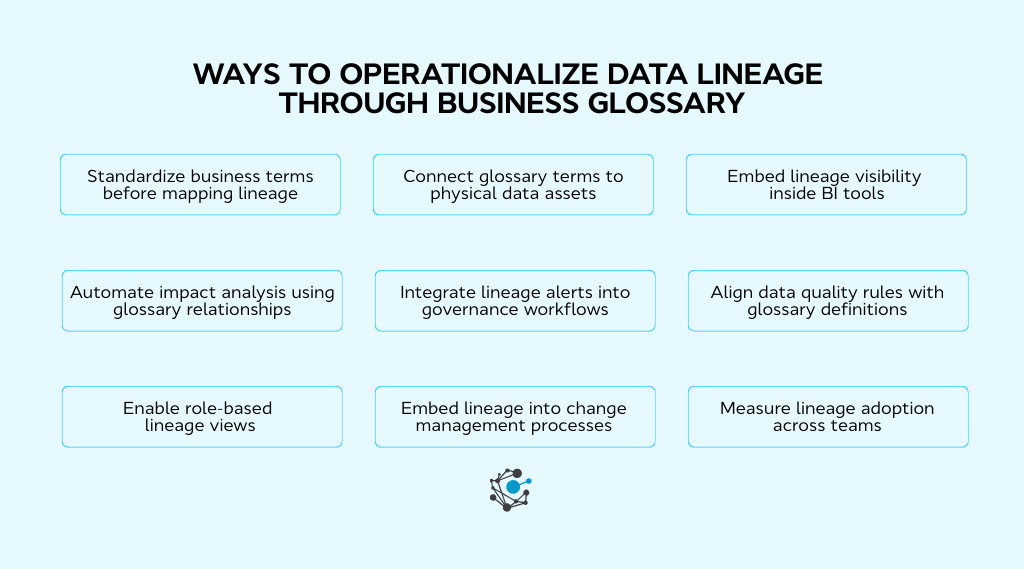
1. Standardize business terms before mapping lineage
Operational lineage starts with clarity around business definitions. When different teams define metrics differently, lineage graphs simply reflect those inconsistencies, which creates confusion instead of trust.
Data governance teams should establish structured processes to define, review, and approve glossary terms before connecting them to technical assets. Once definitions for metrics such as revenue, churn, or customer lifetime value are standardized, lineage can accurately represent how those metrics flow through pipelines and reporting systems.
Without this foundation, lineage visualization may look complete while still representing conflicting business logic.
2. Connect glossary terms to physical data assets
Once business definitions are standardized, the next step is linking those terms directly to datasets, tables, and columns across the data platform.
This step connects technical lineage with the business context that analysts can interpret. A KPI in the glossary should map directly to the warehouse tables and transformation pipelines responsible for producing it.
When someone explores the lineage path of a metric, they should immediately see both the business meaning and the technical data flow. Platforms such as OvalEdge simplify this integration by connecting business glossary, metadata ingestion, and lineage mapping within a unified governance environment.
3. Embed lineage visibility inside BI tools
Lineage becomes truly operational when it appears where data is actually consumed. Instead of forcing analysts to leave dashboards to review lineage diagrams, organizations can surface lineage information directly inside BI tools.
When business users can trace a KPI definition from the dashboard itself, they gain immediate context about upstream tables, pipelines, and business definitions. This transparency allows analysts to validate metrics quickly and reduces the dependency on engineering teams for routine verification.
Over time, this visibility builds greater trust in analytics outputs across the organization.
4. Automate impact analysis using glossary relationships
Glossary relationships create powerful opportunities for automation. When business terms are connected through relationships such as “derived from” or “aggregated from”, lineage systems can automatically evaluate downstream dependencies.
If an engineer updates a pipeline or modifies a schema, the lineage system can instantly identify affected dashboards, reports, and KPIs. Instead of discovering broken reports after deployment, teams gain advanced visibility into downstream impact.
This automation helps organizations move from reactive troubleshooting to proactive governance.
5. Integrate lineage alerts into governance workflows
Operational lineage works best when it actively participates in governance processes. Rather than simply displaying lineage information, the system should trigger alerts when upstream logic or schema structures change.
These alerts can integrate with workflow tools so governance teams receive immediate notifications when changes affect critical business metrics or datasets. Instead of manually monitoring pipelines, teams receive automated signals that guide investigation and review.
|
Did you know? This kind of workflow integration helps address the exact barriers many teams still face. Drexel LeBow and Precisely reported that the top execution challenges for data programs were cost (54%), lack of effective data management tools (49%), poor data quality (45%), and lack of awareness and adoption (45%). Embedding lineage alerts into governance workflows helps reduce that operational friction. |
This approach strengthens governance automation and ensures that lineage insights influence operational workflows.
6. Align data quality rules with glossary definitions
Data quality monitoring becomes far more meaningful when it reflects approved business definitions. Instead of writing rules tied only to pipeline logic, organizations can align quality checks with glossary definitions of key metrics.
For example, if the glossary defines revenue in a specific way, quality checks should validate the datasets and transformations responsible for producing that metric. When a rule fails, lineage immediately reveals which dashboards and reports depend on the affected data.
This connection accelerates root cause analysis and ensures that quality monitoring aligns with business expectations.
7. Enable role-based lineage views
Not every user needs the same level of lineage detail. Data engineers may require full pipeline visibility, while finance or compliance teams typically focus on how business metrics connect to reports and dashboards.
Role-based lineage views present lineage based on audience needs. Engineers see transformation logic and technical metadata, while business users see simplified paths linked to KPIs and glossary terms. This makes lineage easier to interpret and improves adoption across teams.
8. Embed lineage into change management processes
One of the most powerful ways to operationalize lineage is by integrating it into deployment workflows. Schema updates, ETL changes, or KPI modifications should pass through lineage validation checkpoints before reaching production.
When CI/CD pipelines include lineage checks, teams can detect downstream reporting or compliance risks before approving a change. If a modification affects critical dashboards or regulatory datasets, the deployment process pauses until stakeholders review the impact.
This approach transforms lineage from a visualization tool into a governance safeguard.
9. Measure lineage adoption across teams
Operational lineage requires measurable outcomes. Organizations should track how often lineage supports decision-making and governance activities.
Key indicators include glossary coverage across datasets, the number of reports linked to lineage paths, automated impact analysis usage, and governance alerts triggered through lineage systems. Monitoring these signals helps governance leaders determine whether lineage truly influences daily workflows.
Without measurement, lineage initiatives often remain technical capabilities rather than operational practices.
|
Stat: Measurement matters because perceived maturity can be misleading. Actian’s 2025 study found that 83% of organizations face data governance and compliance challenges, yet they rated their own governance maturity at 4.13 out of 5. That gap is a strong reminder that lineage adoption should be measured through workflow usage and business outcomes, not assumed from tool deployment alone. |
As these practices mature, organizations begin to see lineage functioning less like documentation and more like an operational control layer across the data ecosystem. At that point, the conversation shifts from how to embed lineage to what value it delivers across governance, analytics, and compliance operations.
Key benefits of glossary-enabled lineage operationalization
When organizations connect business glossary definitions with technical lineage, governance begins to shift from reactive problem-solving to proactive control. This shift makes lineage a governance capability that supports everyday decision-making across engineering, analytics, and compliance teams.
Several practical benefits begin to emerge once glossary-enabled lineage becomes operational:
-
Reduced change-related risk: Automated impact analysis helps teams identify which dashboards, reports, or KPIs depend on a dataset before schema updates or pipeline changes are deployed. This visibility prevents unexpected reporting disruptions and allows teams to review business impact early.
-
Faster compliance and audit validation: When business definitions link directly to data assets and transformation pipelines, compliance teams can trace how metrics are produced without manual investigation. This traceability simplifies audit reviews and regulatory reporting.
-
Stronger trust in analytics: Analysts and business users gain confidence in metrics because they can easily see both the meaning of a KPI and the data sources behind it. Clear lineage paths reduce confusion around how numbers are calculated.
-
Improved governance automation: Workflow-driven lineage reduces the need for manual ticket reviews and reactive investigations. Governance teams receive alerts, impact insights, and validation signals automatically when upstream logic changes.
Over time, these improvements compound. Lineage stops being a passive diagram inside a catalog and begins functioning as an operational layer that supports governance, analytics, and data operations across the enterprise.
As organizations begin to see these outcomes, attention naturally turns to how lineage should integrate with the broader governance architecture. Connecting glossary definitions and lineage workflows is only the first step; designing the right operational framework determines whether those capabilities scale effectively across teams.
Implementation framework for lineage workflow integration
Operationalizing lineage does not happen overnight. Most organizations already have pieces of the puzzle, such as a business glossary, lineage diagrams, or metadata catalogs. The real work lies in connecting these capabilities to governance workflows and daily data operations, so lineage actively supports decision-making.
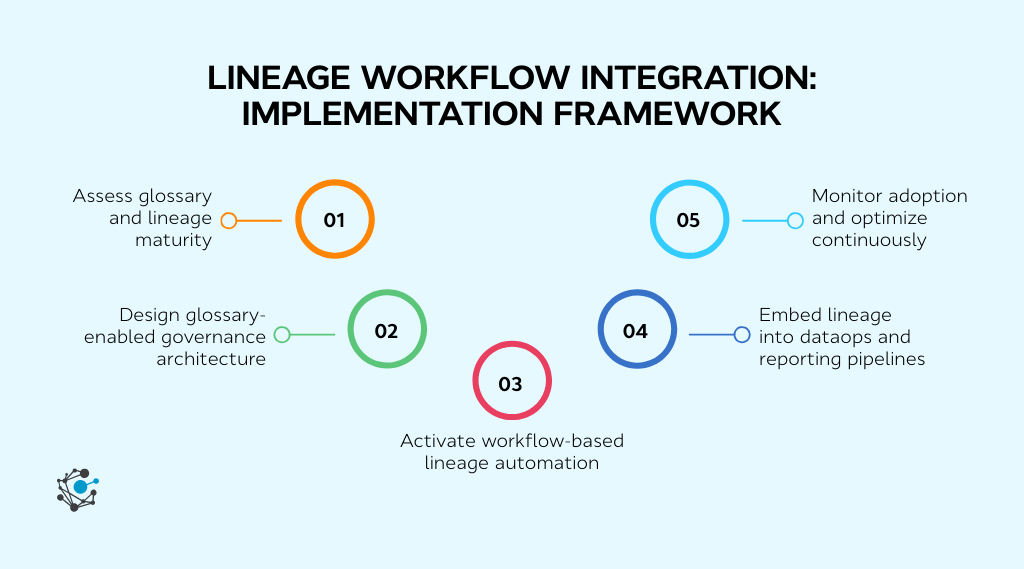
Step 1: Assess glossary and lineage maturity
The first step is understanding the current maturity of both glossary and lineage systems. Governance teams should evaluate how complete the business glossary is, how deeply lineage captures upstream and downstream dependencies, and whether these systems connect to operational workflows.
Many organizations discover that lineage exists only in technical catalogs, while glossary definitions remain disconnected from actual data assets. Without linking these layers, lineage provides visibility but rarely supports governance decisions.
Step 2: Design glossary-enabled governance architecture
Once maturity gaps are identified, organizations can design an architecture that connects business definitions, metadata ingestion, lineage engines, and governance workflows.
The objective is to create a unified environment where glossary definitions, lineage mapping, and governance automation interact seamlessly. When these components operate together, lineage insights can flow directly into reporting systems, data platforms, and compliance processes.
|
Platforms such as OvalEdge simplify this architecture by tightly integrating business glossary management, automated metadata ingestion, and end-to-end lineage visualization within a single governance platform. |
This unified approach helps organizations connect business context with technical traceability while supporting governance automation across the data ecosystem.
Step 3: Activate workflow-based lineage automation
Once the architecture is in place, organizations can activate automation across governance workflows. Lineage insights should trigger actions across BI tools, governance systems, and DevOps pipelines.
For example, if an upstream transformation affects a KPI defined in the glossary, automated alerts can notify data owners and governance teams immediately. Instead of waiting for issues to surface in reports, teams receive early signals that guide investigation and approval workflows.
Step 4: Embed lineage into data operations and reporting pipelines
Operational lineage becomes most effective when it integrates directly into production processes. Deployment pipelines, report certification workflows, and KPI logic updates should include lineage validation checkpoints before changes are approved.
Embedding lineage checks within CI/CD pipelines and reporting workflows ensures that every update passes through a governance-aware validation layer. This approach reduces unexpected downstream impact and improves the reliability of analytics outputs.
Step 5: Monitor adoption and optimize continuously
Even the most well-designed governance framework requires continuous monitoring. Organizations should track metrics such as glossary coverage, lineage mapping completeness, workflow automation usage, and governance alerts triggered through lineage systems.
These signals reveal how effectively lineage integrates into daily operations. As adoption grows, governance teams can refine workflows, expand glossary coverage, and improve automation to strengthen operational lineage across the enterprise.
When organizations connect glossary definitions, lineage insights, and governance workflows through a structured framework, lineage begins to influence decisions rather than simply document data flows.
However, turning this framework into a reliable governance capability requires avoiding several common operational pitfalls that often slow down lineage adoption.
Best practices to avoid common lineage operationalization challenges
Even with the right architecture and tools in place, many organizations struggle to turn lineage into an operational governance capability. The issue usually isn’t the technology itself. More often, it’s how lineage and glossary systems are used, maintained, and integrated into everyday workflows.
Keeping a few practical best practices in mind can help teams avoid the most common pitfalls.
-
Do not treat the glossary as static documentation: Keep glossary terms actively linked to data assets and workflows. Data stewards should review definitions regularly and maintain clear ownership.
-
Prioritize workflow integration over diagram complexity: Lineage delivers value when embedded into dashboards, deployment approvals, and governance processes, not when diagrams become more detailed.
-
Make lineage accessible to business users: Provide simplified, role-based lineage views that connect directly to the KPIs teams use every day.
-
Define adoption metrics early: Track signals such as glossary coverage, lineage-linked dashboards, and impact analysis usage to measure operational adoption.
When these practices become part of governance culture, lineage moves beyond documentation and begins functioning as a reliable operational control layer.
At that point, lineage adoption stops being an initiative and becomes a natural part of how organizations manage and trust their data.
Conclusion
When lineage connects directly with business glossary definitions and governance workflows, it becomes far more than documentation.
Teams can assess change impact before deployments, validate KPIs within dashboards, investigate data quality issues faster, and demonstrate clear traceability during audits.
Over time, this approach turns lineage into an operational governance layer across the data ecosystem. Engineering teams gain visibility into downstream dependencies, governance teams strengthen audit readiness, and business stakeholders gain confidence in the metrics they rely on for decisions.
Platforms like OvalEdge support this shift by connecting glossary definitions, metadata ingestion, lineage visualization, and governance workflows in one environment. Organizations can then move beyond static lineage diagrams and build governance frameworks where lineage actively supports daily operations.

Schedule a demo with OvalEdge and see how glossary-enabled lineage can become an operational layer across your data platform.
FAQs
1. How long does it take to operationalize data lineage in an enterprise environment?
Operationalizing data lineage typically takes 3 to 9 months, depending on metadata maturity, integration complexity, and governance readiness. Organizations with centralized catalogs and automated ingestion accelerate adoption compared to fragmented, manually documented environments.
2. What is the difference between technical lineage and operational lineage?
Technical lineage visualizes data movement across systems. Operational lineage embeds those insights into workflows such as change approvals, compliance checks, and reporting validation, ensuring lineage actively influences business processes instead of remaining a reference artifact.
3. Can small or mid-sized organizations operationalize lineage effectively?
Yes. Mid-sized organizations can operationalize lineage by prioritizing critical business domains first, focusing on high-impact reports and KPIs. Starting with domain-level glossary linkage ensures faster ROI before expanding enterprise-wide coverage.
4. How does operational lineage support regulatory audits?
Operational lineage provides traceable evidence of how business metrics are derived, who modified transformation logic, and when changes occurred. This structured traceability simplifies audit preparation and reduces dependency on manual documentation.
5. What tools are required to embed lineage into workflows?
Effective lineage workflow integration requires automated metadata ingestion, business glossary management, API connectivity with BI tools, and governance workflow automation. Platforms that unify these capabilities reduce integration overhead and improve long-term scalability.
6. How do you prioritize which data domains to operationalize first?
Start with revenue-impacting KPIs, regulatory reporting datasets, or frequently changing pipelines. Prioritizing high-risk and high-visibility data domains ensures measurable impact, executive support, and stronger cross-functional adoption during early rollout phases.
Deep-dive whitepapers on modern data governance and agentic analytics
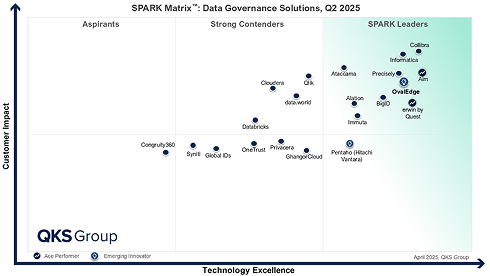
OvalEdge Recognized as a Leader in Data Governance Solutions
3ff1.png)
“Reference customers have repeatedly mentioned the great customer service they receive along with the support for their custom requirements, facilitating time to value. OvalEdge fits well with organizations prioritizing business user empowerment within their data governance strategy.”
aef2.png)
“Reference customers have repeatedly mentioned the great customer service they receive along with the support for their custom requirements, facilitating time to value. OvalEdge fits well with organizations prioritizing business user empowerment within their data governance strategy.”
Gartner, Magic Quadrant for Data and Analytics Governance Platforms, January 2025
Gartner does not endorse any vendor, product or service depicted in its research publications, and does not advise technology users to select only those vendors with the highest ratings or other designation. Gartner research publications consist of the opinions of Gartner’s research organization and should not be construed as statements of fact. Gartner disclaims all warranties, expressed or implied, with respect to this research, including any warranties of merchantability or fitness for a particular purpose.
GARTNER and MAGIC QUADRANT are registered trademarks of Gartner, Inc. and/or its affiliates in the U.S. and internationally and are used herein with permission. All rights reserved.